Creative and AI 9 min read
AI Ad Copy Generator for Meta Ads: Copy From the Creative
An AI ad copy generator for Meta Ads that transcribes the video, reads the landing page and writes TOFU, MOFU and BOFU copy in 9 languages. Examples, limits.

Contents
- What is an AI Copywriting Agent for Meta Ads?
- Why does copywriting block creative scaling?
- What does AI copy generation not solve?
- How can copy be written from the creative itself?
- Example: one creative, three funnel stages
- Copywriting agent, ChatGPT or ad copy generator: which one?
- Which plans include the Copywriting Agent?
An AI copywriting agent for Meta Ads writes each ad’s primary text, headline and description from what the creative shows and says. Apogee’s agent transcribes video voiceovers, analyzes static visuals, reads your landing page, then spreads its copy across TOFU, MOFU and BOFU, in nine languages. It is included on the Pro and Scale plans. It does not pick your angle or your offer, and its copy gets reviewed before launch.
What is an AI Copywriting Agent for Meta Ads?
Fifty creatives land in your upload queue and the copy doc has three approved lines in it: every ad launches with the same recycled primary text, whatever the visual actually says. An AI Copywriting Agent addresses exactly this: a system that generates your Meta ad copy (primary text, headline, description) by analyzing the content of each creative. Unlike a typical ad copy generator, which starts from a prompt, an agent built for Meta Ads starts from the asset and works within the platform’s constraints, starting with character limits and the funnel stage. A TOFU (top of funnel) text that educates does a different job from a BOFU (bottom of funnel) text that drives purchase, and both need to come out of the same creative.
You could also paste a brief into ChatGPT or Claude in a chat window and get decent copy back. But a general-purpose LLM does not see the creative it is writing for, does not know the character limits of each Meta placement, and pushes nothing to your ad account: you still copy and paste every variant by hand. The difference is not the quality of the writing, it is the connection between the creative, the platform constraints, and the upload flow.
Why does copywriting block creative scaling?
When you launch 50 creatives per week, writing 3 copy variants per ad means 150 texts. Most teams end up recycling the same copy across all their creatives. The result: a disconnect between the creative’s visual message and the accompanying text. A customer testimonial video paired with a promotional offer text tells two stories at once. For videos, the problem is even worse: nobody has time to watch each video to write copy that aligns with the message. Copywriting becomes the bottleneck of creative scaling, not because it is difficult, but because the volume makes the process impossible to sustain.
Bulk upload solves the launch side: a folder of creatives becomes campaigns, ad sets and ads in one pass. Without copy matched to each creative, that saved time is paid back in consistency.
Copywriting at scale fails on volume, not difficulty: 50 creatives with 3 variants each means 150 texts per week. Recycling one copy across all of them avoids the workload but disconnects the text from what each visual says.
What does AI copy generation not solve?
Generated copy is a starting point, not a finished strategy. The agent writes text that is consistent with your creative, but it does not decide which angles deserve to be tested or which audience each message should reach: that remains your job. Automating copywriting also does not fix a weak offer, since no headline saves a product nobody wants at that price. Plan to review the output for brand voice and compliance before launch.
Three concrete limits apply to Apogee’s Copywriting Agent:
- The agent writes from what the creative contains. A video with no voiceover and no on-screen text gives it little to work with, and the output will show it.
- You choose the target funnel stage, not the agent. It writes for a stage; it does not decide that a creative is a discovery creative.
- The agent is limited to the Pro and Scale plans. The Starter plan does not include it.
One last point plays out on Meta’s side, after publishing: Advantage+ creative enhancements include “text improvements”, which can change what actually gets delivered. Apogee exposes the eleven Advantage+ enhancements one by one, all turned off by default, on the Pro and Scale plans.
How can copy be written from the creative itself?
Apogee’s Copywriting Agent analyzes each creative before generating copy. The workflow has five steps.
-
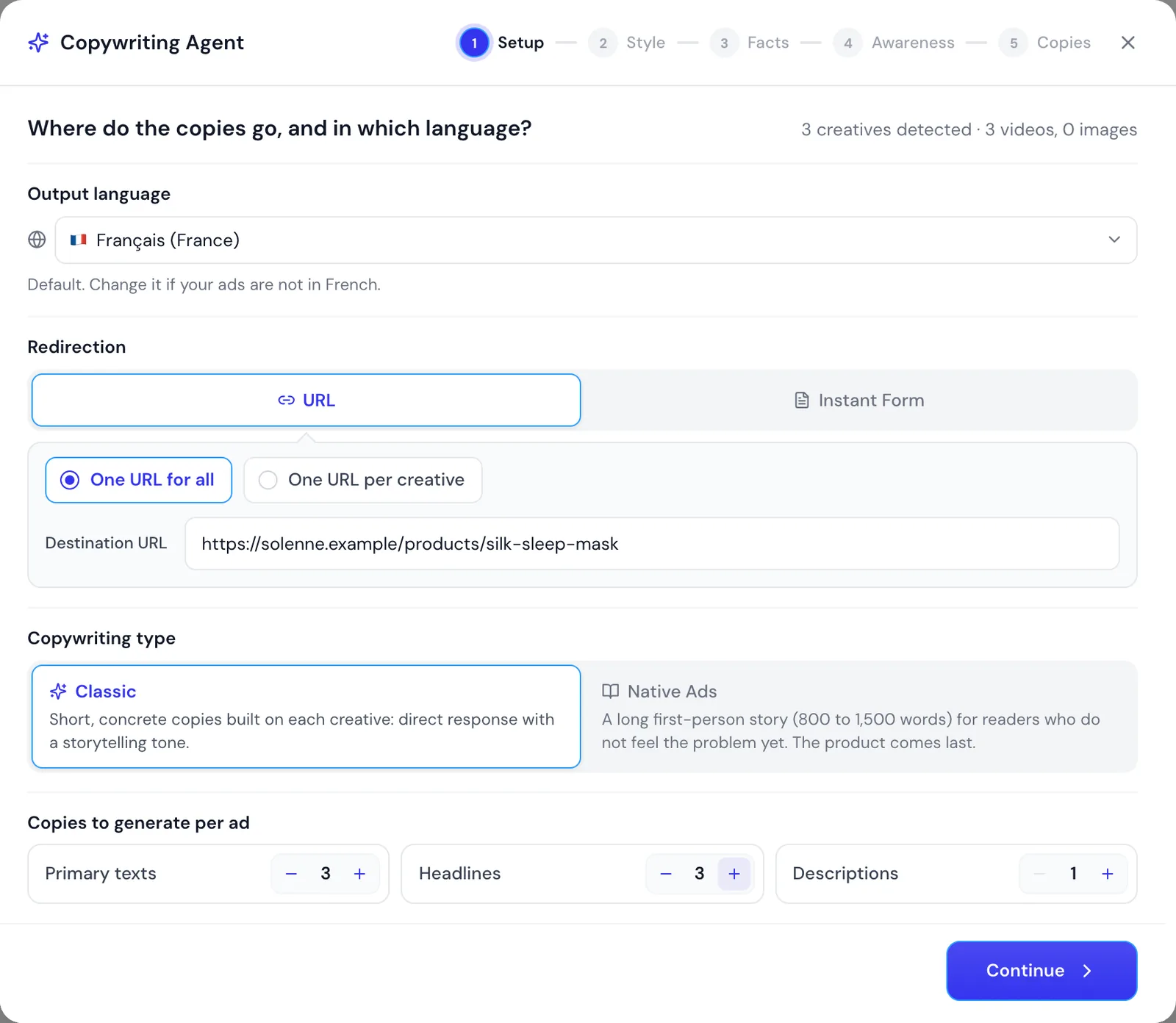
Reading the creative. For a video, the agent extracts the audio and transcribes the entire voiceover or UGC script. For an image, it runs a visual analysis that catalogues what the static contains. The exact transcript, or the visual analysis, is shown in the review panel with its character count before anything is generated: you see what the agent understood.
-
Reading the destination page. The agent then reads the site the ad points to: one URL for the whole batch, or one per creative, with bulk assignment across a selection. For a lead ad, it detects there is no page and writes for the form flow.
-
Settings. Before running it, you set the funnel stage, the style, the volume, your examples and the language:
- the funnel stage: from three variations onward, copy is spread across TOFU, MOFU and BOFU, each carrying its tag;
- the style: classic direct response, or native ads, meaning first-person, long-form copy anchored on the creative’s own scene and voice;
- the volume: how many primary texts, headlines and descriptions per ad;
- your examples: up to five per field, to steer tone and structure toward yours;
- the output language, out of nine: French (France), French (Quebec), English (US), English (UK), Spanish, German, Italian, Dutch and Portuguese (Brazil).
-
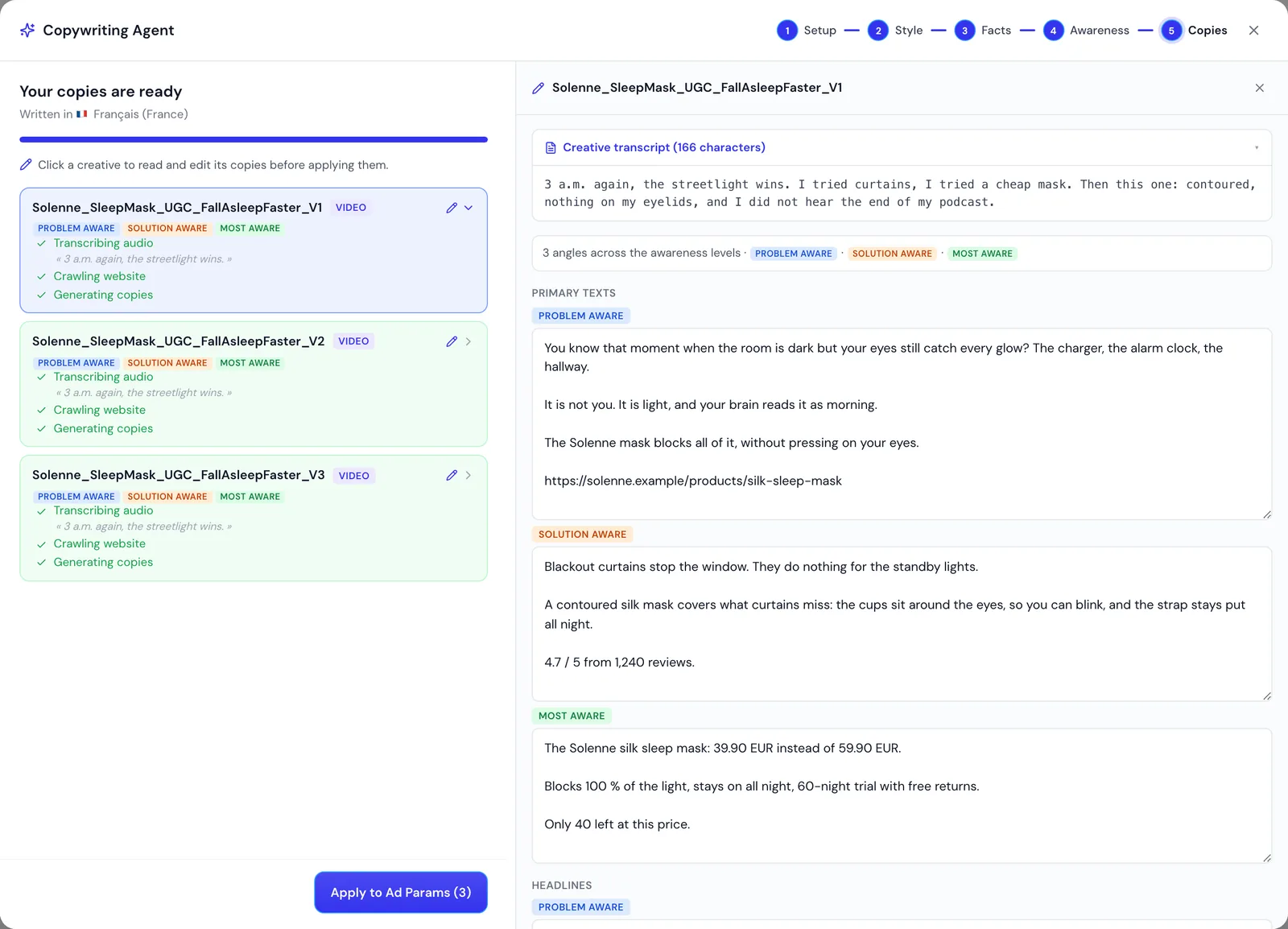
Generation and review. Each creative gets its own card, streaming its steps live: transcribing audio or analyzing the creative, crawling the site, generating. The review panel stays editable.
-
Applying at launch. One button writes the generated copy into every ad at once, then a banner moves on to the rest of the setup: Facebook Page, Instagram account and tracking.
For these steps, Apogee relies on Claude, OpenAI and Gemini: its privacy policy assigns video audio transcription to OpenAI and the analysis of creative images and videos to Gemini.
The funnel stage is your choice, not the agent’s guess: you select TOFU, MOFU, or BOFU, and the agent writes copy for that stage from the same creative. An educating text and a purchase-driving text can come from one asset.
Example: one creative, three funnel stages
The example below was built for this article: the brand is fictional, and the copy shows the logic of the split, not output copied from the tool.
The creative is a 20-second UGC video for a carry-on backpack. The voiceover says: “A week in Lisbon, everything in my carry-on, and I opened the bag like a suitcase.” The landing page shows a shirt compartment, a separate shoe pocket and three colors.
| Stage | Primary text | Headline |
|---|---|---|
| TOFU | One week of travel, one carry-on. Lea fit everything in, and she shows how in the video. | Travel with one bag |
| MOFU | Opens flat like a suitcase, shirt compartment, separate shoe pocket: what you see in the video is the bag’s own layout. | Packed like a suitcase |
| BOFU | The bag from the video comes in three colors, carry-on size. Pick yours before your next trip. | Lea’s carry-on bag |
All three texts start from the same voiceover and the same page. The TOFU copy uses the scene, the MOFU copy uses the page’s arguments, the BOFU copy goes to the purchase. If the page announces no discount and no delivery time, none of the three texts should invent one: that is the first thing to check in review.
To feed the per-field examples, your ads’ comments are a direct source: Apogee’s comment analysis pulls hooks from real comments and the customer’s own vocabulary.
Copywriting agent, ChatGPT or ad copy generator: which one?
All three write copy. They do not start from the same place.
| Criterion | ChatGPT or Claude in chat | Ad copy generator | Apogee’s Copywriting Agent |
|---|---|---|---|
| Starting point | Your prompt | Your prompt and a form | The creative and the landing page |
| Sees the video or visual | No | Depends on the tool | Yes: transcript or visual analysis |
| Funnel stage | If you specify it | Depends on the tool | TOFU, MOFU, BOFU, tagged |
| Writes into the Meta ad | No, copy and paste | Depends on the tool | Yes, one button for every ad |
| Use outside Meta (email, landing page) | Yes | Often | No, it writes the ad’s fields |
| Cost | Free tier from these vendors | Varies | Pro and Scale plans, from €99 per seat per month |
The last two rows count against Apogee. For a handful of ads a month, or to also write your emails and pages, a chat LLM is enough. The agent pulls ahead when volume forces you to match dozens of texts to dozens of creatives. If what you need is to produce the visuals themselves, the AdCreative.ai vs Apogee comparison details what each tool does.
An ad copy generator writes from what you describe to it. An agent that transcribes the video writes from what the video actually says, and the gap shows as soon as the creative drifts away from the brief.
Which plans include the Copywriting Agent?
The Copywriting Agent is included on the Pro plan, at €99 per seat per month, and on the Scale plan, at €199 per seat per month. The Starter plan, at €69 per seat per month, does not include it. A 25% discount applies on annual billing.
When a TikTok Ads or Snapchat Ads ad moves back to Meta, the Bridge also has Claude write the primary text, headline and description, editable before launch. To then query your ads’ results in plain language, Autopilot offers a copywriter role among its five agent roles.
Try Apogee for 7 days for €1, with no ad limit.
Related articles: