Tracking and reporting 4 min read
UTM Parameters for Meta Ads at Scale
Which UTM parameters to use on Meta Ads, how to fill them with dynamic tokens instead of by hand, and what breaks when you do not.

Contents
- Which UTM tokens does Meta give you?
- Which UTM template holds up at scale?
- What breaks without proper UTMs?
- Which dependency does nobody mention?
- Where should you set UTMs, and why does it matter?
- Which parameters are worth carrying?
- How do you decide source and medium once?
- How do you check that it works?
- What do UTMs not solve?
UTM parameters on Meta Ads fail for a boring reason: they are typed by hand, once per ad, by people in a hurry. The fix is not discipline. It is tokens.
Which UTM tokens does Meta give you?
| Token | Replaced by |
|---|---|
campaign.name | the campaign name at delivery |
adset.name | the ad set name |
ad.name | the ad name |
placement | feed, story, reels and the rest |
site_source_name | Facebook, Instagram, Messenger, Audience Network |
They are substituted when the ad serves, so the value always matches the entity that produced the click. No copy and paste, no drift.
Which UTM template holds up at scale?
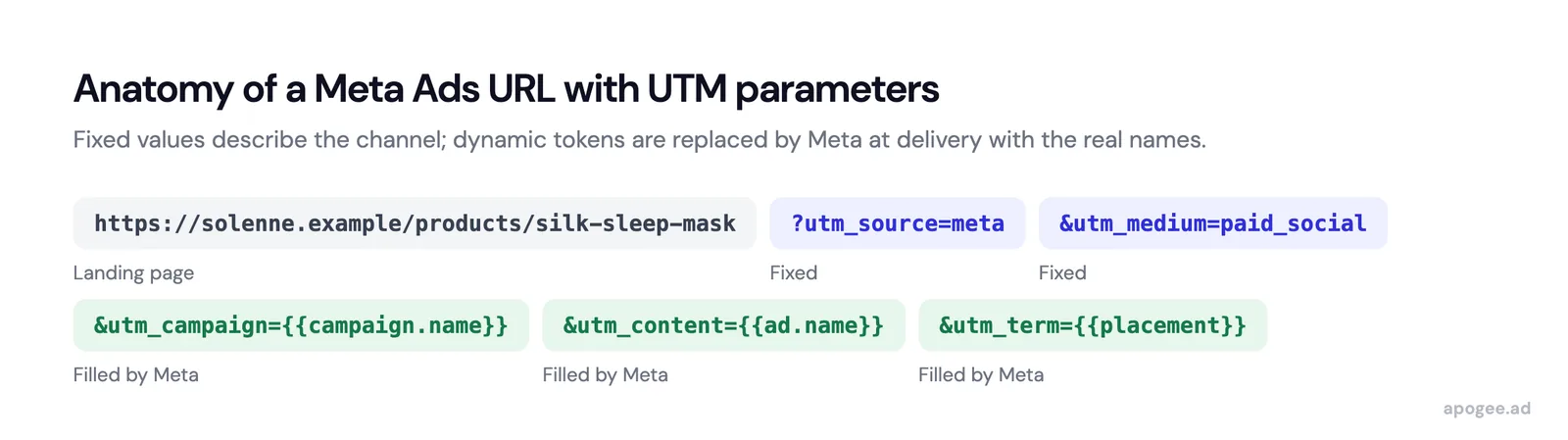
utm_source=meta
utm_medium=paid_social
utm_campaign={{campaign.name}}
utm_content={{ad.name}}
utm_term={{placement}}
Source and medium are constants, because they describe the channel and never change. Everything else is generated.
Put placement in utm_term and you can finally answer whether stories convert differently from feed, which Meta’s own reporting will tell you but your site side analytics will not, unless you pass it.
What breaks without proper UTMs?
One person writes fb, another facebook, a third Facebook. Analytics treats them as three sources and every channel report is wrong by a third.
The same happens at campaign level whenever a campaign is renamed after launch: the UTM keeps the old string, the interface shows the new one, and reconciling the two becomes an afternoon.
Which dependency does nobody mention?
UTM values inherit your naming convention. If ad names are inconsistent, utm_content is inconsistent, and the analytics report is as unreadable as the export it came from. The fix sits upstream, in the naming convention and in campaign names that do not change after launch.
Tokens do not clean names. They propagate them faithfully, including the mess.
Where should you set UTMs, and why does it matter?
Meta gives you two places to put URL parameters, and they behave differently.
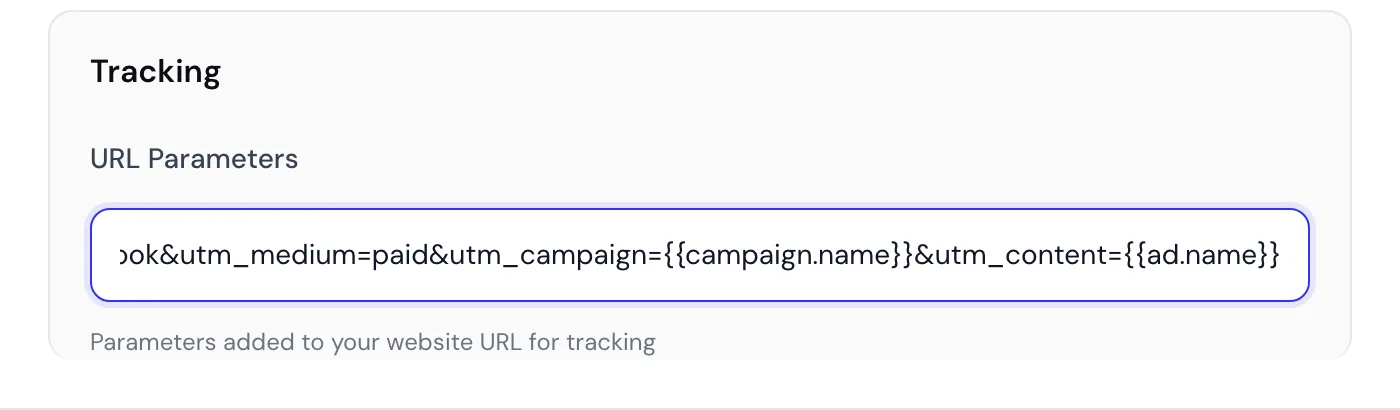
The URL parameters field at ad level (which Apogee’s bulk configuration also fills for a whole batch) holds the query string on its own, separate from the destination URL. It is the right place: the link stays readable, and editing tracking never risks breaking the landing page.
Appending the query string directly to the destination URL works and ages badly. Someone eventually edits the URL to fix a path, deletes half the parameters by accident, and nothing warns you because a URL with broken tracking still loads fine.
Which parameters are worth carrying?
| Parameter | Value | Why |
|---|---|---|
utm_source | a constant, meta | Names the platform, never varies |
utm_medium | a constant, paid_social | Groups with your other paid social |
utm_campaign | {{campaign.name}} | Ties the click to the campaign that served it |
utm_content | {{ad.name}} | The only way to see per creative performance site side |
utm_term | {{placement}} | Separates feed, story and reels |
The split matters because these five values fail differently. The constants fail once, at setup, and stay wrong until someone notices. The generated ones cannot fail that way, since they are read from the entity that served the click.
How do you decide source and medium once?
This sounds trivial and it is the most common failure in the whole exercise.
Pick meta or facebook and write the choice down somewhere the whole team sees. Pick paid_social or cpc and do the same. The values do not matter much in themselves. What matters is that six months of data carries one value rather than four.
An analytics report split across fb, facebook, Facebook and meta is not a reporting problem you can fix later. Historical rows keep the value they were given.
How do you check that it works?
Launch one ad, click it yourself, and look at the landing URL in the address bar.
The tokens should be replaced with real values. If you see the literal string {{ad.name}} in the URL, the parameter was written somewhere that does not support substitution, and every click from that ad is being recorded against a placeholder.
This takes ninety seconds and it is the only verification that actually proves the chain works end to end.
What do UTMs not solve?
UTMs describe where a click came from. They say nothing about what happened after, and they do not reconcile Meta’s attributed conversions with your site side numbers. Those two will not match, and chasing agreement between them is time you will not get back.