Naming conventions 6 min read
Campaign Name Examples for Meta Ads (With Ad Set Names)
Copy-ready Meta Ads campaign name examples for e-commerce, lead gen and agency accounts, with matching ad set and ad names and the rule behind each one.

Contents
- Why does that rule work?
- E-commerce
- Lead generation
- Agency accounts
- Which objective names should the campaign name use?
- How does the rule hold up in hard cases?
- What do the ad set and ad names look like under these campaigns?
- What does a good convention look like written down?
- What does a naming convention not solve?
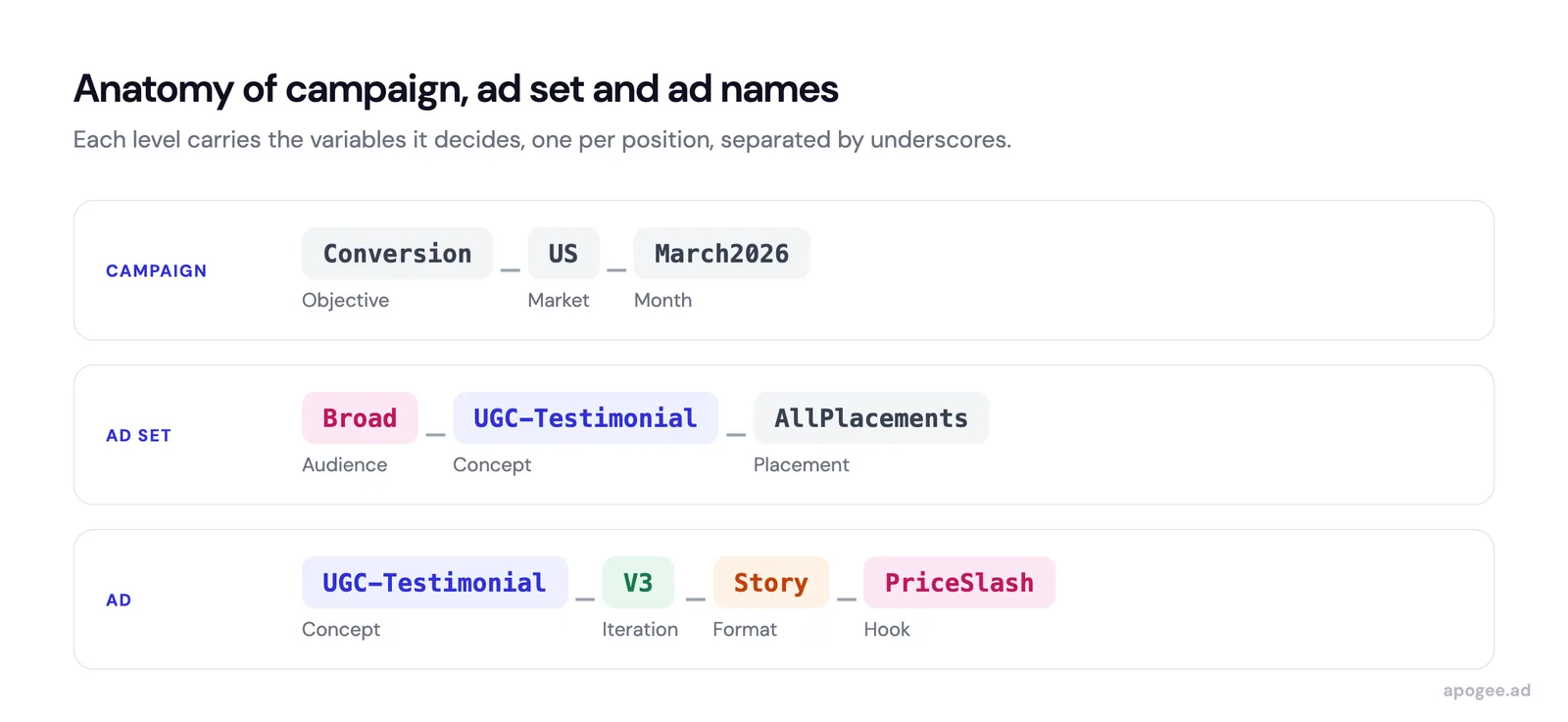
A campaign name is the label you give a campaign in Meta Ads Manager. Meta imposes no format, which is how one account ends up with three formats in the same list. The pattern used across this site, and the one the examples below follow, is [Objective]_[Market]_[Month]: Conversion_US_March2026.
Most campaign naming advice gives you a template and no rule. The template then fails on the first account that does not look like the author’s.
The rule is simpler and it travels: a campaign name carries what was decided at campaign level, and nothing else.
Why does that rule work?
Meta’s hierarchy assigns decisions to levels. The campaign decides the objective and, under CBO, the budget. The ad set decides who sees the ad and where. The ad decides what they see.
A name that mirrors that hierarchy stays readable as the account grows, because each level answers only the questions it actually controls. A name that mixes levels stops being filterable the moment you have more than one of anything.
E-commerce
Conversion_US_March2026
Conversion_UK_Evergreen
Conversion_FR_BlackFriday2026
Objective, market, period. That is the base pattern used across this site, and it holds for most accounts without modification.
The period earns its slot on seasonal accounts and is dead weight on evergreen ones, which is why the second example carries Evergreen rather than a month. If every campaign in your account would carry the same value for a variable, that variable is not telling you anything.
Lead generation
Lead_US_InstantForm
Lead_US_Website
Lead_DE_Evergreen
Here the destination takes the period slot, because instant form leads and website leads differ enough in cost and in quality that mixing them under one campaign produces an average describing neither. The pattern is unchanged, the third variable is simply the one that matters on this account.
Agency accounts
ClientA_Conversion_US_March2026
ClientB_Lead_FR_Evergreen
ClientA_Conversion_US_Testing
The client is added in front of the base pattern rather than replacing part of it. It survives truncation in interfaces that cut long names, and it is the filter an agency reaches for before any other. The agency account structure guide covers the rest of the multi-account setup.
The third line shows an extension worth adopting: a separate testing campaign, marked as such, so exploratory spend never contaminates the numbers you report as performance.
Which objective names should the campaign name use?
Meta Ads Manager offers six objectives: Awareness, Traffic, Engagement, Leads, App promotion and Sales. Meta’s help center maps the older objectives onto these six and states that some of them, Conversions and Messages among them, no longer exist. The lead generation objective is now called Leads, catalog sales now sit under Sales, and former Conversions campaigns map to Engagement, Leads or Sales depending on the conversion location.
The examples on this site keep Conversion as the label for sales campaigns. That works because the label is consistent everywhere, not because it matches Meta’s wording. If you are writing a convention from scratch today, using Meta’s current names (Sales, Leads, Traffic, Awareness) has one advantage: the name and the objective column in Ads Manager say the same thing, so nobody has to translate.
What breaks reporting is mixing the two. Conversion_US_March2026 and Sales_US_April2026 in the same account are two values for one objective, and every filter on the first word now misses half the campaigns.
The same care applies to Advantage+ products if they appear in your names or your documentation. Meta’s help center writes them with a capital A and a lowercase second word: Advantage+ creative, Advantage+ audience, Advantage+ placements, Advantage+ campaign budget.
How does the rule hold up in hard cases?
Should the name repeat the objective, when Meta stores it as a field?
Yes. It makes a list scannable without opening filters, and scanning is what you actually do twenty times a day.
Should it carry the creation date?
No. Meta stores it and shows it as a sortable column. A date in the name adds characters you cannot spend twice and gets misparsed by tools looking for identifiers.
Should it carry the audience?
No. That belongs to the ad set, and putting it at campaign level usually means the account has one campaign per audience, which is a structural problem a name cannot fix.
Should it say Advantage+?
Only when the account runs Advantage+ campaigns next to manually configured ones, for the same reason as budget mode: a variable earns its slot only if it takes more than one value in the account. The creative settings do not belong here at all, since Advantage+ creative enhancements are set per ad. Apogee’s Advantage+ controls handle those at launch.
What do the ad set and ad names look like under these campaigns?
The campaign name is the first of three. Under Conversion_US_March2026, the full set reads like this:
| Level | Pattern | Example |
|---|---|---|
| Campaign | [Objective]_[Market]_[Month] | Conversion_US_March2026 |
| Ad Set | [Audience]_[Concept]_[Placement] | Broad_UGC-Testimonial_AllPlacements |
| Ad | [Concept]_[Iteration]_[Format]_[Hook] | UGC-Testimonial_V3_Story_PriceSlash |
Each level answers only its own question. The ad set name does not repeat the objective, and the ad name does not repeat the audience, because both are already one level up. More ad set examples by account type are in Meta ad set name examples, and the full convention, with ad names and three account types, is in the Meta Ads naming convention guide.
The ad name usually starts life as a file name. If your creative files already follow [Concept]_[Iteration]_[Format], the ad name is half written: see the file naming convention for ad creatives.
What does a good convention look like written down?
The convention is not the examples. It is the specification, and it fits in five lines:
Pattern:    [Client_][Objective]_[Market]_[Month]
Separator:  underscore between variables, hyphen inside a variable
Objective:  Conversion | Lead | Traffic | Awareness
Market:     ISO country code, uppercase
Optional:   budget mode, only if the account runs CBO and ABO side by side
Written down, it can be handed to a new hire. Held in one person’s head, it degrades the week that person is on holiday.
A written convention also pays off outside Ads Manager. Meta’s dynamic URL parameters can pass the campaign.name token into your UTM tags, so a clean campaign name becomes a clean campaign value in your analytics. The UTM parameters guide shows the setup.
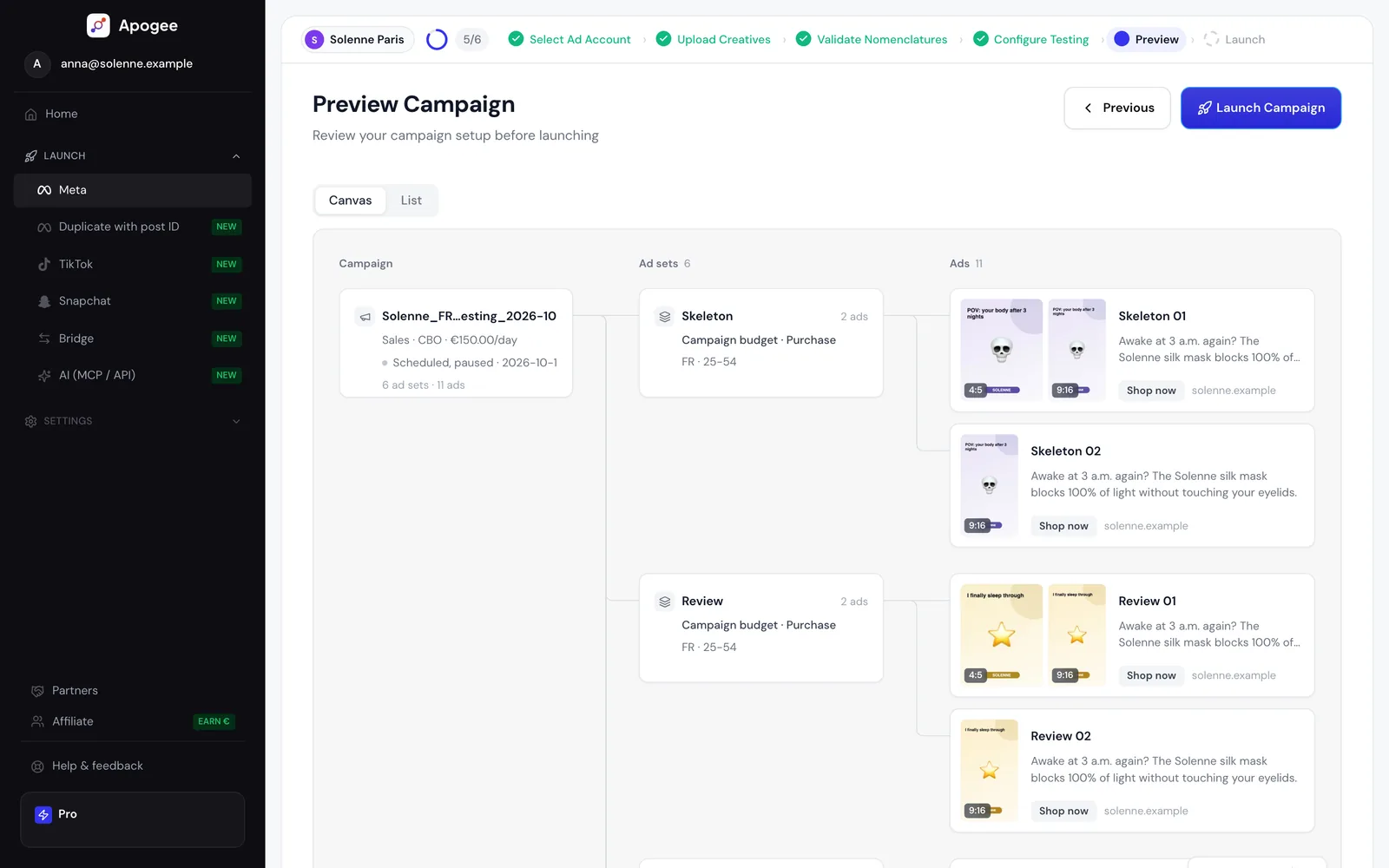
Apogee’s AI naming detection reads the convention you already use in your file names and applies it to every campaign, ad set and ad of a bulk upload. The same detection feeds TikTok Ads and Snapchat Ads launches. You can try it for 7 days for €1, with no ad limit.
What does a naming convention not solve?
Naming makes an account legible. It does not make it well structured. Twelve campaigns with immaculate names, all chasing the same audience, still bid against each other in the same auction and still cost you the difference. How many campaigns an account actually needs is covered in Meta Ads campaign structure.
A convention also only holds while everyone applies it. The moment one person types a name by hand at the end of a long day, the grouping breaks for that campaign and for every report that includes it, silently, until someone notices the totals no longer add up.