Bulk upload 5 min read
Running Meta Ads Across Many Client Accounts
How agencies handle naming, access and reporting across a dozen Meta ad accounts without rebuilding the same setup for every client.

Contents
- What prefix should every client account use?
- Can one naming pattern serve every client?
- How should you set up access across clients?
- What breaks first when you scale to many accounts?
- How do you handle team permissions per client?
- How does billing work across client accounts?
- What reporting limit hits agencies first?
- What does account structure not solve?
Running one Meta account well is a media buying problem. Running twelve is an operations problem, and the failure is almost never in the delivery.
What prefix should every client account use?
ClientA_Conversion_US_CBO_Q1-2026
ClientB_Lead_FR_ABO_Evergreen
ClientC_Conversion_UK_CBO_Evergreen
The client goes first. It is the position that survives truncation in every interface that cuts long names, and it is the first filter anyone applies to a consolidated export.
Without it, a report across twelve accounts is twelve reports, opened one at a time, reconciled by hand. More patterns are in campaign name examples and ad set name examples.
Can one naming pattern serve every client?
There are two tempting extremes and both fail.
Imposing one full convention on every client never survives contact with their existing habits, their legacy campaigns and the person on their side who has named things their way for three years.
Letting every account do its own thing destroys consolidated reporting on day one.
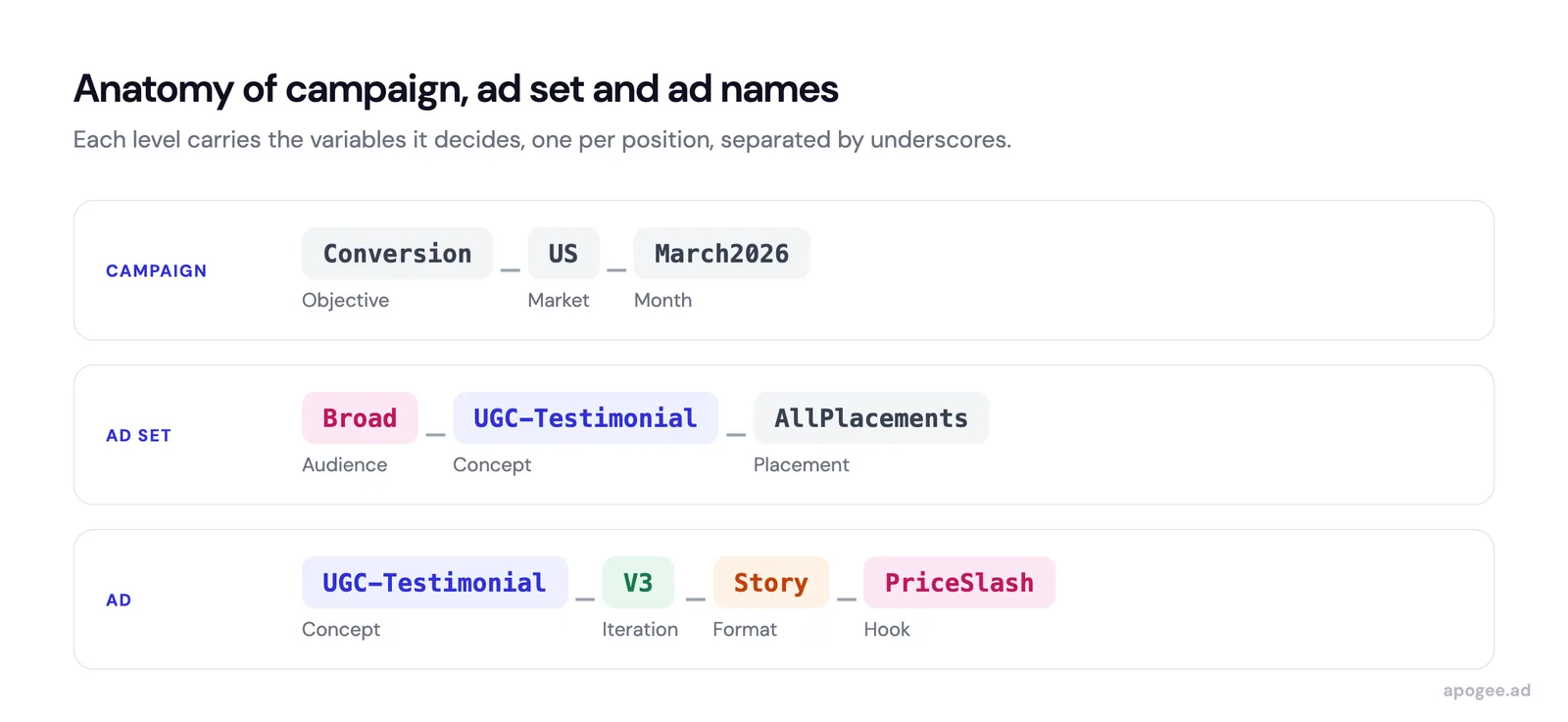
The workable middle is the same pattern everywhere, different values inside it. Client, objective, market, audience, concept. ClientA calls a concept SkincareRoutine and ClientB calls the same idea MorningRitual, and both remain filterable because the position is identical.
You are standardising structure, not vocabulary. Vocabulary is the client’s.
How should you set up access across clients?
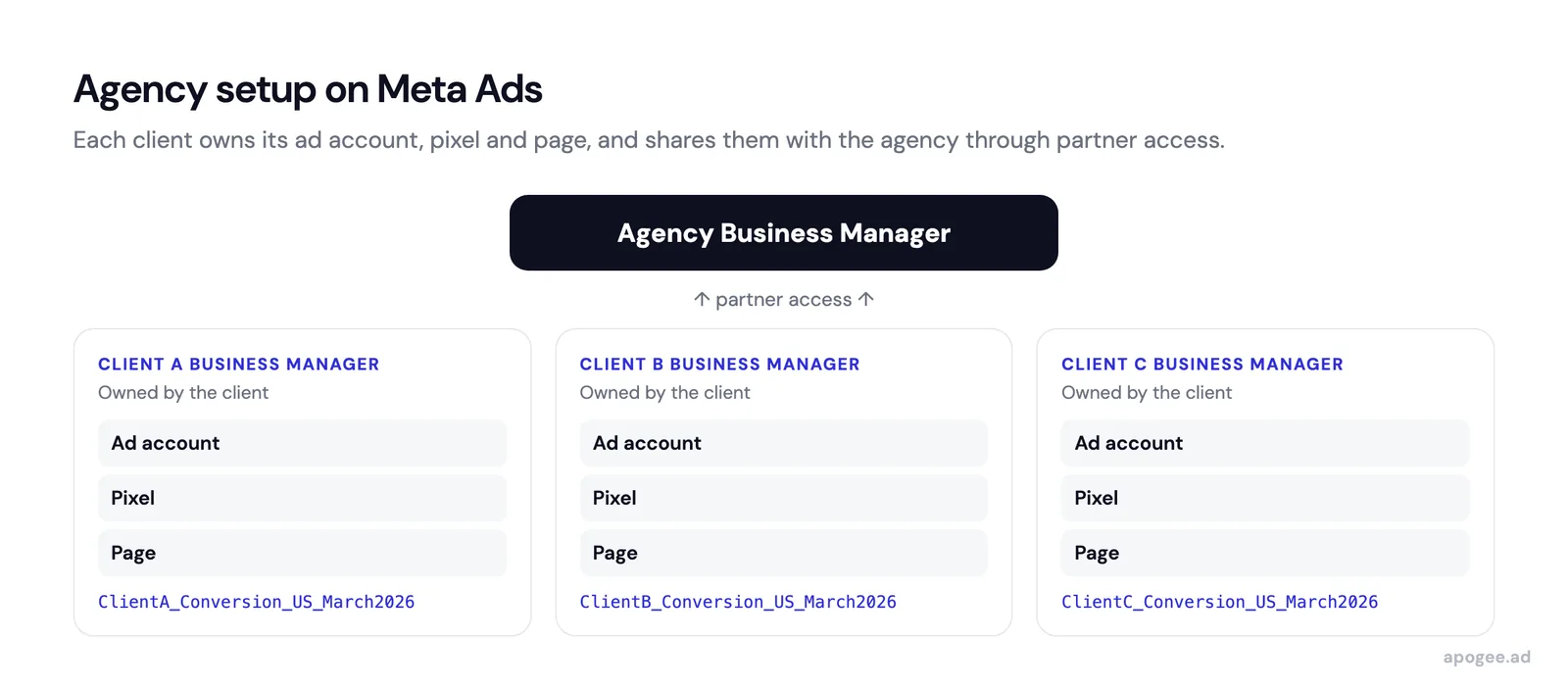
Ad accounts should be owned by the client’s Business Manager and shared with the agency through partner access.
| Setup | What happens when someone leaves |
|---|---|
| Access on a personal profile | Access leaves with them |
| Agency Business Manager, partner link | Seat removed, account keeps working |
The second row is the entire argument. The first setup works perfectly until the day it does not, and that day is always a Friday.
The same logic applies to pixels, catalogues and pages: owned by the client, shared to the agency. An agency that owns a client’s pixel has created a hostage situation it will regret during offboarding.
What breaks first when you scale to many accounts?
Not delivery. Reporting.
The moment two accounts spell the same variable differently, the consolidated view is wrong. It stays wrong quietly, because nothing errors and no dashboard turns red, until a client asks a question the numbers cannot answer and someone spends a day finding out why.
This is why the naming convention matters more for an agency than for an in house team. An in house team notices drift because they live in one account. An agency notices it in a quarterly review.
How do you handle team permissions per client?
Business Manager grants roles per asset, not per agency. That is a feature and it is the part teams skip.
A junior media buyer needs to create and edit ads on the three accounts they run. They do not need billing access on any of them, and they do not need admin on the client’s Business Manager. Granting one blanket level to everybody is faster on day one and becomes the reason an intern can change a payment method in month four.
| Role | Who needs it |
|---|---|
| Admin on the agency Business Manager | One or two people, permanently |
| Advertiser on a client ad account | The buyers actually running it |
| Analyst on a client ad account | Account managers, reporting, the client’s own team |
| Billing access | Whoever reconciles invoices, and nobody else |
Review the list when someone joins and when someone leaves. The second review is the one that gets forgotten.
How does billing work across client accounts?
Two arrangements exist and they are not equivalent.
The client pays Meta directly, with their own payment method on their own ad account. Spend never touches the agency’s books, disputes are between the client and Meta, and the agency invoices fees only. This is the arrangement most agencies should want.
The agency pays Meta and rebills. It gives the agency control and it turns the agency into a credit provider: spend lands on the agency’s card in real time, client payment arrives thirty or sixty days later, and a client who churns leaves the spend behind. Agencies that do this without a spending cap per account discover the exposure during a scaling month.
Whichever applies, the ad account should still be owned by the client. Payment method and ownership are separate settings, and conflating them is what makes offboarding painful.
What reporting limit hits agencies first?
Meta attributes conversions per account, using its own windows and its own view of the user.
Summing attributed conversions across twelve accounts does not give you total performance. It gives you a number that double counts in ways you cannot measure and cannot correct. Presenting it as a total is a claim the data does not support.
Report per account. If a portfolio level number is genuinely needed, build it from spend and from the client’s own revenue data, not from Meta’s attributed conversions.
What does account structure not solve?
Structure and naming make an agency legible to itself. They do not make the work good, and a beautifully organised account can lose money at scale with perfect traceability.
Nor do they replace the conversation. A client who does not understand why the account is structured the way it is will ask for a campaign per product by the second month, and no convention survives being overruled.