Naming conventions 4 min read
File Naming Convention for Ad Creatives
How to name creative files so a bulk upload tool reads concept, iteration and format automatically, and so your reporting can group them afterwards.

Contents
- What are the three parts of a creative file name?
- Which separator should you use?
- How do you name iterations so they sort correctly?
- Which format keywords should file names carry?
- What breaks automatic grouping?
- Why should file names stay ASCII?
- Where does the convention have to be applied?
- What does a file naming convention not solve?
A creative file name is the only piece of metadata that follows a video from the editor’s timeline to the ad account to the reporting export. It survives every handoff, and almost nobody spends thirty seconds designing it.
What are the three parts of a creative file name?
SkincareRoutine_V2_9x16.mp4
UsVsThem_Hook1_1x1.jpg
ProductDemo_V3_4x5.png
BeforeAfter_H2_16x9.mp4
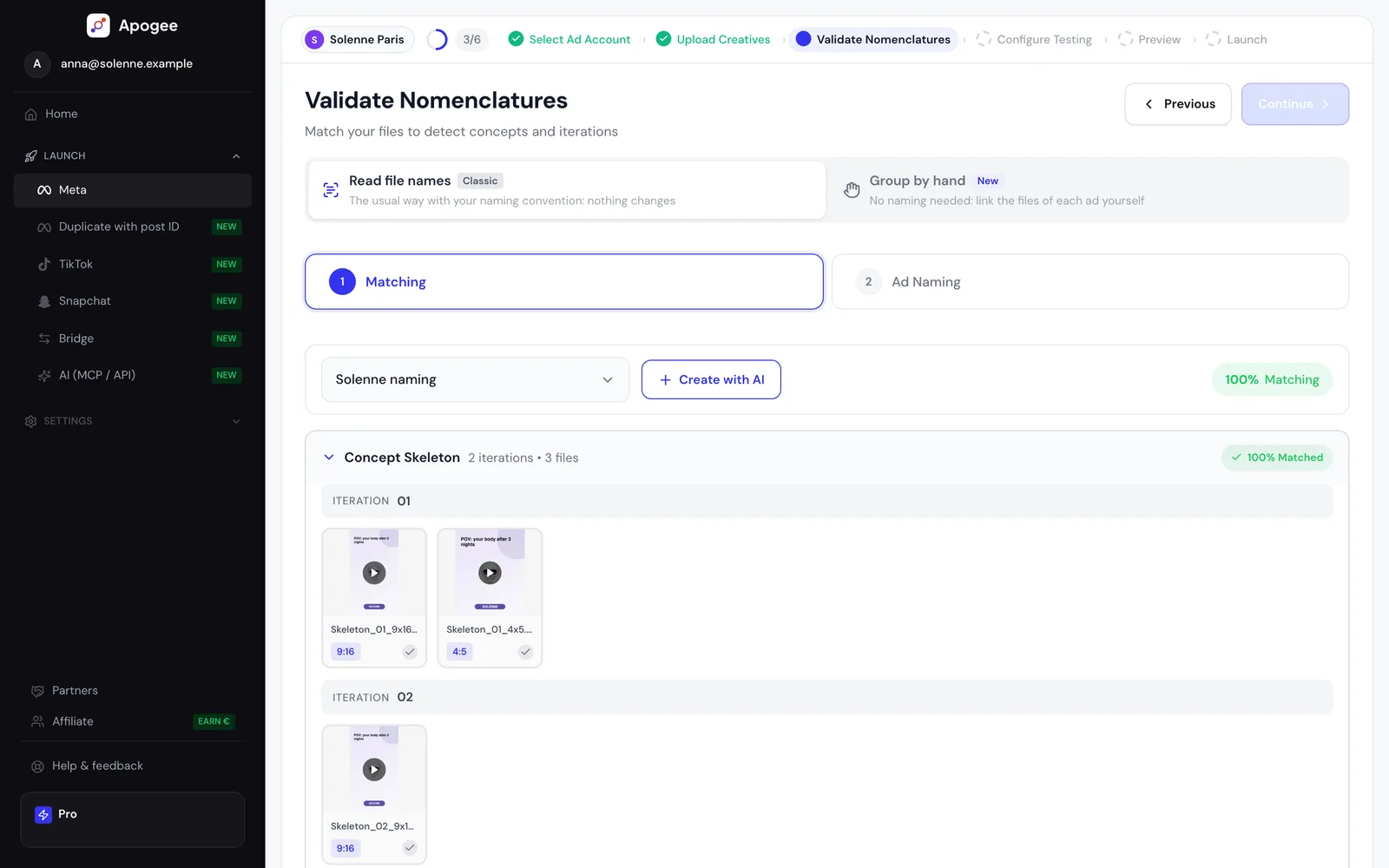
Concept is the angle you are testing. Iteration is the variation of that angle. Format is the aspect ratio. The same three variables then carry into the ad name, as set out in the Meta Ads naming convention guide.
Those three carry three different questions. Concept answers which idea works. Iteration answers which version of that idea works. Format answers which ratio works per placement. A name that carries all three lets you ask all three, months later, from a spreadsheet.

Which separator should you use?
Underscores separate variables. Hyphens join words inside a variable.
UsVsThem_Hook1_9x16.mp4        three variables, unambiguous
Us-Vs-Them_Hook-1_9x16.mp4     three variables, still unambiguous
Us_Vs_Them_Hook_1_9x16.mp4     six variables, or three, nobody can tell
The third line is the problem. Once one separator does both jobs, no tool and no human can reliably say where a variable ends. This single rule prevents more downstream mess than any other part of a convention.
How do you name iterations so they sort correctly?
Iterations accumulate faster than anyone plans for. Two conventions work, and mixing them does not.
| Style | Example | Reads as |
|---|---|---|
| Version | V1, V2, V3 | successive edits of one idea |
| Hook | H1, H2, H3 | different openings, same body |
Version numbering suits a creative being refined. Hook numbering suits a body being tested against several openings, which is the more common case in performance work.
Pick one per concept and stay with it. A folder containing V2 and Hook2 for the same concept means nobody knows whether those are two things or the same thing twice.
Which format keywords should file names carry?
9x16   vertical, story, reels
4x5    the feed workhorse
1x1    square
16x9   landscape
Writing the ratio in the name is redundant with the file’s own dimensions, and it is worth doing anyway. Which ratio each placement expects is covered in multi-format ads on Meta.
The reason is confirmation. When a name says 9x16 and the media measures 1080 by 1080, something went wrong at export, and you would rather find that before the ad is live than after a week of stories serving a cropped square.
What breaks automatic grouping?
| Name | What a tool can extract |
|---|---|
SkincareRoutine_V2_9x16.mp4 | concept, iteration, format |
skincare routine v2.mp4 | a guess, at best |
final_v2_FINAL.mp4 | nothing usable |
IMG_4821.mp4 | nothing at all |
Copy of Copy of ad.mp4 | nothing, plus a story |
The last three are not hypothetical. They are what a shared drive looks like after one week of production with three people in it.
Why should file names stay ASCII?
No spaces, no accents, no ampersands, no parentheses.
Letters, digits, underscores and hyphens travel unchanged through file systems, upload APIs, spreadsheets and reporting exports. Everything else gets percent encoded, transliterated or silently replaced somewhere along the chain, and the name you get back at the reporting end is not the name you gave at the editing end.
A concept named Créa Été becomes three different strings depending on where it passed. That is three concepts in your aggregate.
Where does the convention have to be applied?
At export, by the person exporting.
This is the part most teams get wrong, and it is not a tooling problem. A media buyer who receives two hundred files named Comp 1_final_v3.mp4 has two bad options: rename them all, which costs more than the convention ever saved, or upload them as they are and lose the reporting.
Give the editor the pattern, in writing, with three examples. It is a thirty second instruction that saves an afternoon every week. The Meta Ads naming template is a ready-made version to hand over.
What does a file naming convention not solve?
A naming convention describes the creative. It says nothing about whether the creative was worth making, and a perfectly named batch of weak concepts is still a weak batch.
It also cannot be enforced by hope. Conventions hold when they are written down and applied at the point of export, and they degrade the first week nobody checks.
And no convention recovers information that was never captured. If nobody recorded which hook a file used, the file name cannot invent it later.