Test structure 9 min read
Meta Ads Learning Phase: Significant Edits That Reset It
The significant edits Meta says restart the learning phase, the 50-result rule, how long learning lasts, and what to do when an ad set is learning limited.

Contents
- What does the learning phase actually measure?
- How long does the learning phase last?
- What resets the learning phase?
- Which edits do not restart learning?
- Why does isolating creatives make learning harder?
- How do you feed an ad set that already works?
- What does “learning limited” mean?
- What does the learning phase mean for testing?
- What are the practical consequences?
- What does the learning phase not explain?
Nearly every account has paused an ad set that was still in learning, and nearly every one of those decisions was made on numbers that meant nothing yet. The learning phase is not a penalty and not a countdown. It is a statement about how much data the delivery system has to work with.
The short version, from Meta’s own help pages: an ad set usually exits learning after about 50 results in the week after its last significant edit. A significant edit is any change to targeting, creative or optimization event, adding a new ad, changing the bid strategy, or pausing the ad set for 7 days or longer. Budget and bid amounts count only when the change is large. The rest of this article is what that means for how you edit, test and structure an account.
What does the learning phase actually measure?
Meta’s help page on the learning phase says ad sets exit it “as soon as they can deliver stably”, which usually happens after about 50 results in the week after the ad set’s last significant edit. The result is whatever you optimized for: a purchase, a lead, a registration.
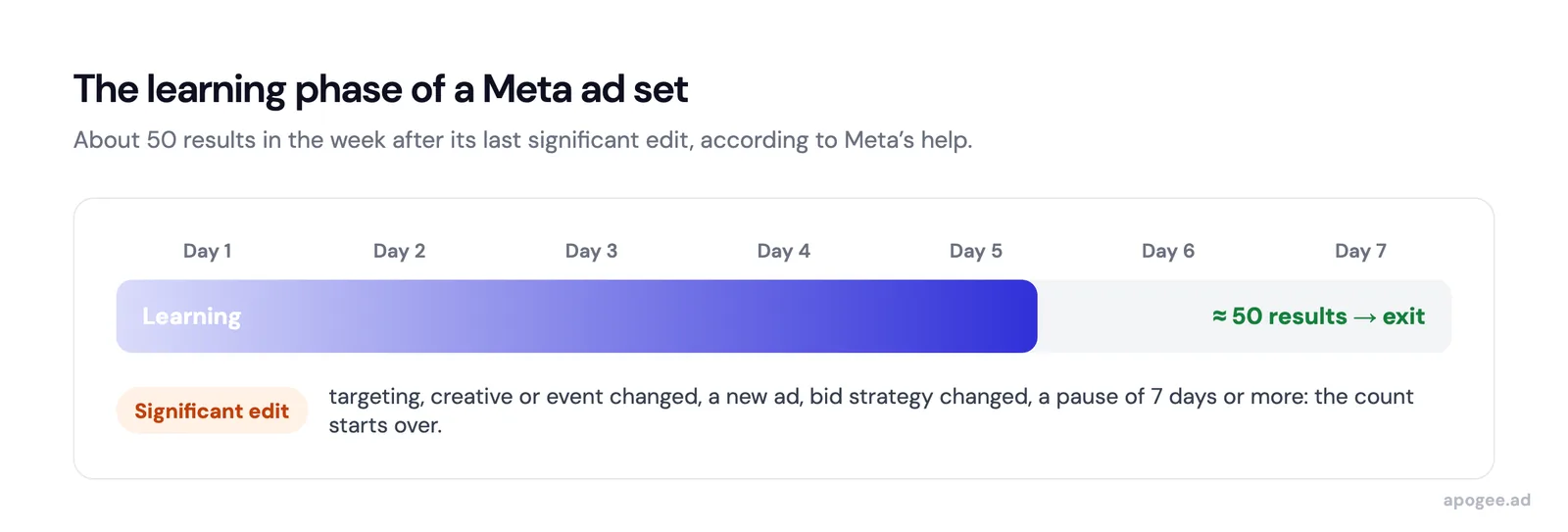
Two consequences follow. The threshold is per ad set, not per campaign. And the count restarts with every significant edit, so an ad set producing eight conversions a week will not exit, no matter how long it runs.
How long does the learning phase last?
There is no fixed duration. Learning is not a seven day timer that runs out; it ends when the results arrive. An ad set that collects 50 purchases in four days exits in four days. One that collects twenty a week stays in learning and, sooner or later, gets marked learning limited.
To see where an ad set stands, Meta suggests adding two columns in Ads Manager: Last significant edit, which shows when learning last restarted, and Results, to count what came in since. Shops ads follow their own rule: 17 purchases through your website and 5 through Meta.
What resets the learning phase?
Meta’s page on significant edits and the learning phase splits edits into two groups.
| Always a significant edit | Significant only if the change is large |
|---|---|
| Any change to targeting | Budget amount |
| Any change to ad creative | Ad set spending limit amount |
| Any change to optimization event | Bid control, cost per result goal or ROAS goal amount |
| Adding a new ad to the ad set | |
| Pausing the ad set for 7 days or longer | |
| Changing bid strategy |
For the second column, Meta gives one example and no threshold: going from $100 to $101 is unlikely to restart learning, going from $100 to $1,000 may. Anyone quoting an exact percentage is guessing, and the guess is not Meta’s.
Two campaign-level cases catch people out. Under Advantage+ campaign budget, which Meta also calls campaign budget and media buyers still call CBO, changing the campaign budget or switching the campaign bid strategy can send several ad sets back into learning at once. And changing the disclaimer on ads about social issues, elections or politics also counts as a significant edit.
Which edits do not restart learning?
Every edit affects delivery a little, but Meta is explicit that only significant edits send an ad set back into learning. A few cases it confirms:
- Small budget adjustments, such as the $100 to $101 example.
- Advantage+ campaign budget moving money between ad sets: the ad sets do not re-enter learning as the budget is distributed.
- A significant edit on one ad set, made at ad set level: the other ad sets of the same campaign are not affected.
- Adding a new ad set to a campaign with Advantage+ campaign budget: the existing ad sets stay where they are.
Meta’s advice that sits on top of all this is to wait until an ad set is out of learning before editing it, and to edit only when you have a reason to expect the change to improve performance.
Why does isolating creatives make learning harder?
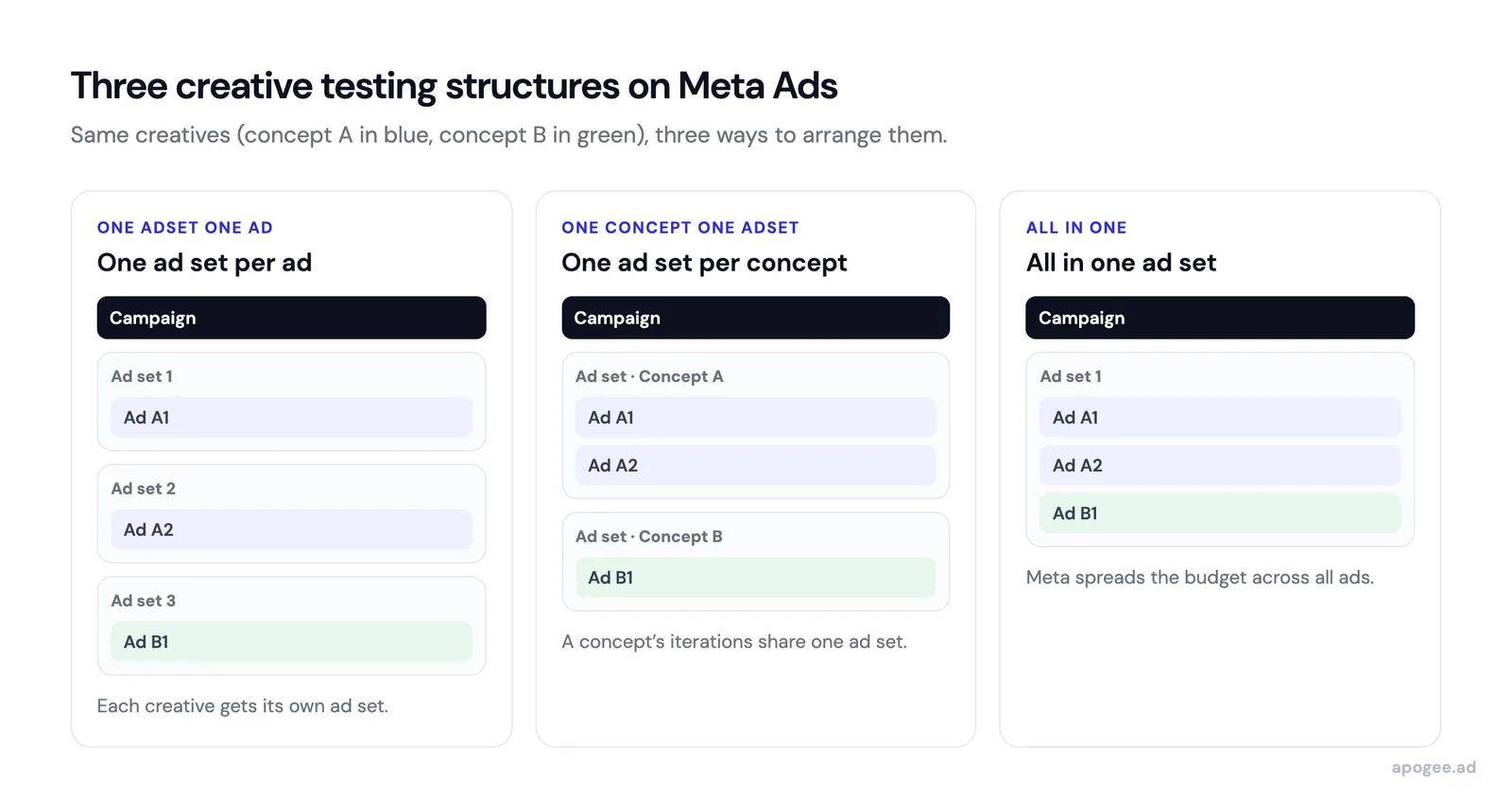
One ad set per creative gives the cleanest possible read: no internal competition, every creative gets its own delivery.
It also multiplies the number of ad sets that each need fifty events. At a constant budget, ten isolated creatives means each ad set gets a tenth of the money and needs the same fifty events. Meta makes the same point in its guidance on managing ad volume: when an advertiser runs too many ads at once, each ad delivers less often and fewer ads exit learning.
| Structure | Read quality | Budget per ad set |
|---|---|---|
| One ad set per creative | cleanest | lowest |
| One ad set per concept | good per angle | moderate |
| Everything in one ad set | weakest | highest |
There is no free option here. The structure that reads best is the one that starves fastest. The trade-offs between these structures are detailed in one ad set one ad and all in one vs one concept one ad set.
How do you feed an ad set that already works?
Meta lists adding a new ad to an ad set as a significant edit, so feeding a winner restarts its learning. No structure and no tool avoids that.
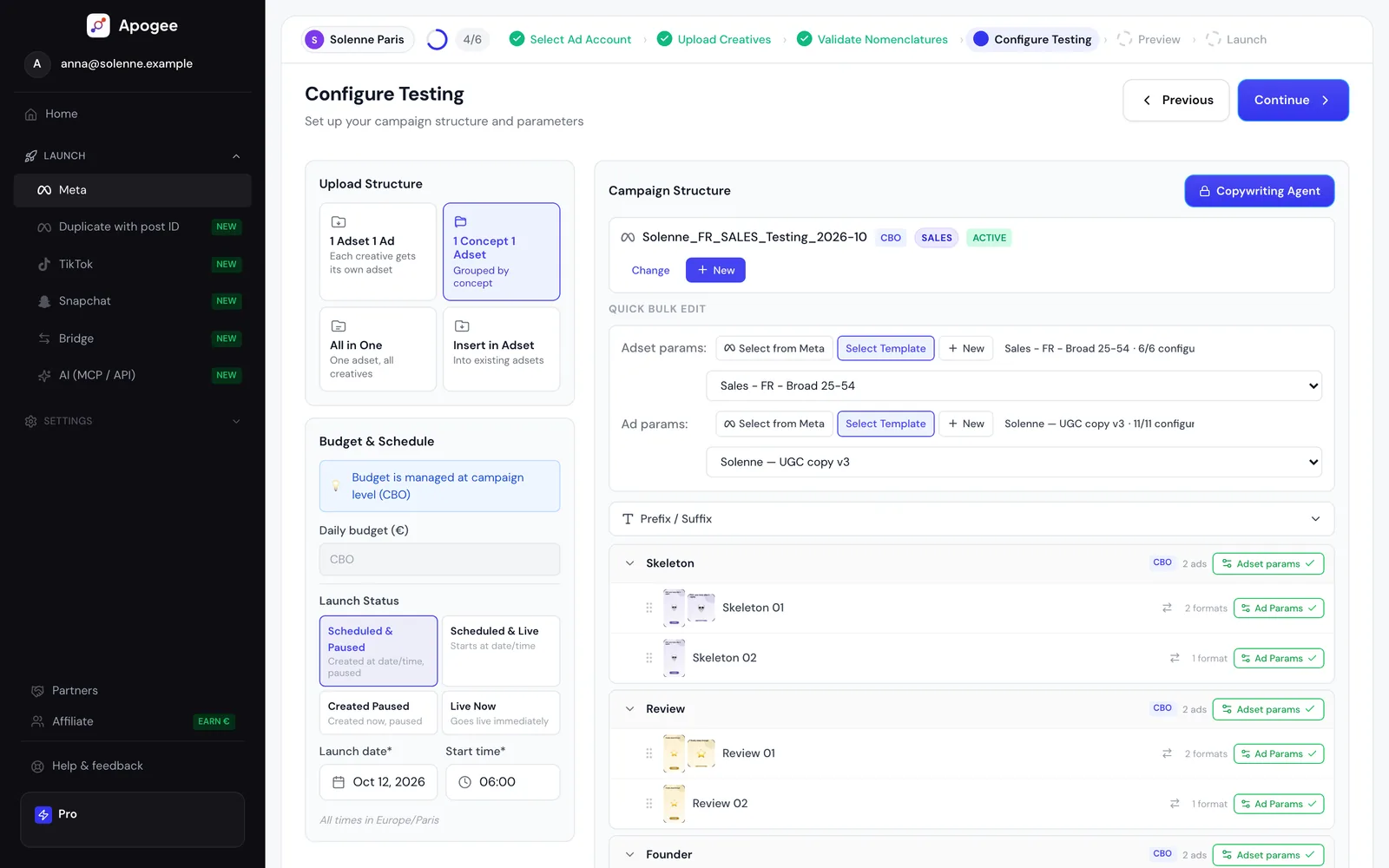
What you choose is where the new results land. A new ad set starts its own count from zero and competes for the same budget. An ad inserted into the ad set that already works restarts learning there, but keeps every result in one place. That is the logic of Apogee’s insert mode in its testing structures: new ads go into existing ad sets, picked by campaign, rather than into new ones.
Two habits reduce the cost. Insert in batches, so five new ads cost one restart instead of five. And insert into ad sets that already produce enough results to get back out of learning within a week.
What does “learning limited” mean?
Meta’s page about learning limited defines it precisely: an ad set becomes learning limited when it is unlikely to receive about 50 optimization events in the week after its last significant edit. The diagnosis can appear at any time after you create the ad set or edit it significantly. Meta adds that it “isn’t a penalty”.
That is not a phase to wait out. It is a statement that the ad set, as set up, cannot gather enough events. Meta names the usual causes: a small audience, a low budget, a low bid or cost control, high auction overlap, an infrequent optimization event, or too many ads running at the same time.
The fixes are structural rather than tactical:
- Combine several small ad sets or campaigns into one
- Move to a more frequent optimization event, for example add to cart rather than purchase, and accept the weaker signal
- Raise the budget so the ad set can actually reach fifty events
- Raise the bid or cost control if it is the constraint
- Widen the audience
Each of these is a real trade. Optimizing on a shallower event gets you out of learning limited and gives Meta a less valuable signal to optimize against.
What does the learning phase mean for testing?
The learning phase quietly sets a ceiling on how many things you can test at once.
If your account produces two hundred conversions a week, it can support roughly four ad sets out of learning at a time, and that assumes the conversions split evenly, which they rarely do. Not ten, and certainly not thirty. The arithmetic is unforgiving and it does not care how many creatives are waiting in the folder.
| Weekly conversions | Ad sets that can exit learning, at best |
|---|---|
| 50 | 1 |
| 100 | 2 |
| 200 | 4 |
| 500 | 10 |
This table is the most useful thing to know before choosing a testing structure. It converts a strategic preference into an arithmetic constraint. For how that constraint shapes the number of campaigns and ad sets, see Meta Ads campaign structure.
What are the practical consequences?
Batch your edits. Five separate changes over five days can restart learning five times. The same five changes made together cost one restart.
Test creative inside a stable ad set when the budget is small. Isolation reads better and starves faster. Below the volume that supports several ad sets, grouping iterations of one concept is the better compromise.
Do not judge an ad set still in learning. Meta says it plainly: during learning, performance is less stable and results are not necessarily indicative of future performance. Killing a creative on day two based on them is how good concepts get discarded.
Apogee’s insert mode and testing structures exist on Meta, and their equivalents exist for TikTok ad groups and Snapchat ad squads, through the same bulk upload workflow. The learning rules in this article are Meta’s: TikTok Ads and Snapchat Ads have their own.
What does the learning phase not explain?
Exiting the learning phase does not mean the ad set is good. It means Meta has enough data to deliver with confidence. An ad set can exit learning and still lose money at a steady, well understood rate.
And the fifty event figure is guidance, not a guarantee: Meta writes that exiting “usually” happens around that number. Accounts with irregular conversion patterns can sit in learning limited for weeks without any edit at all.