Test structure 9 min read
How Many Ads Per Ad Set? One Ad Per Ad Set on Meta
One ad per ad set isolates each Meta creative, at a budget cost. How many ads per ad set, ABO vs CBO for testing, budget per ad set, reading results.

Contents
- What is the One AdSet One Ad method?
- Why is creative testing hard on Meta?
- How many ads should you put in one ad set?
- ABO or CBO for a one ad per ad set test?
- How much budget does each ad set need?
- What does the method not solve?
- How do you read the results of a one ad per ad set test?
- Common mistakes with one ad per ad set
- One ad per ad set vs Ads Manager’s built-in creative test
- How do you launch a One AdSet One Ad structure fast?
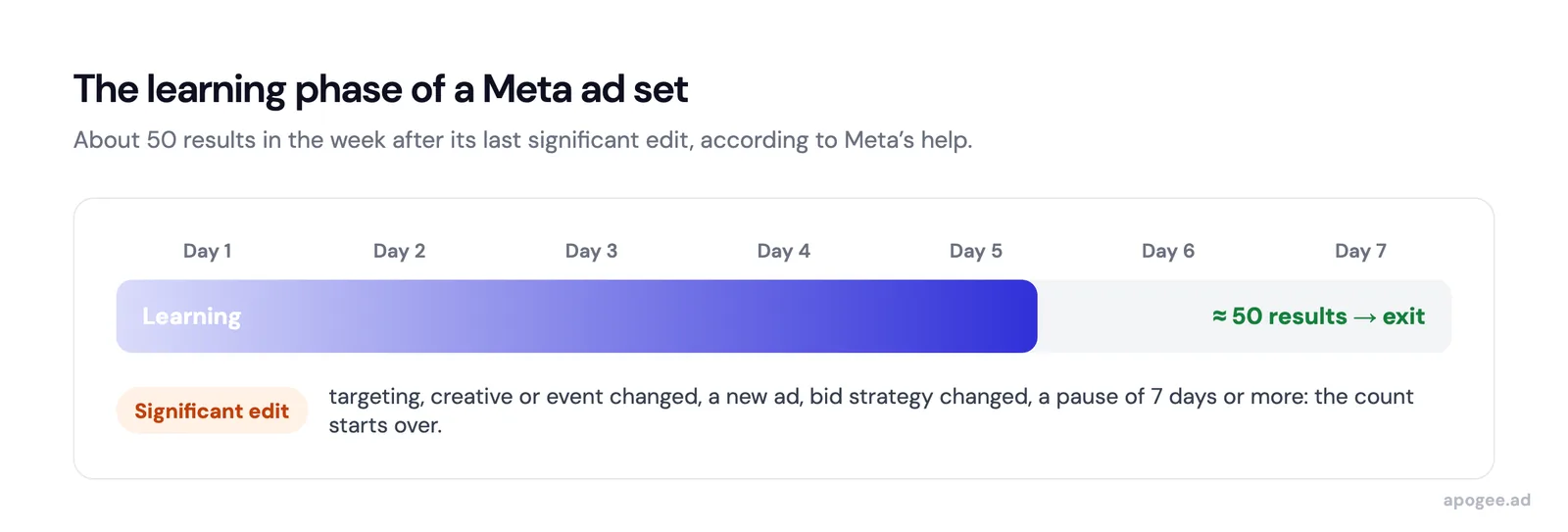
One AdSet One Ad (1:1), often searched as one ad per ad set, puts a single ad in each Meta ad set: every creative gets its own budget and its own numbers, with no internal competition. It gives the cleanest read on a creative, and it is the most expensive way to get one. According to Meta’s help center, an ad set usually exits the learning phase after about 50 results in the week following its last significant edit, so each isolated creative has to be funded to that level. The method makes sense when the budget allows it, under ABO. Otherwise, grouping iterations of one concept in a shared ad set gives a more reliable read for the same money.
What is the One AdSet One Ad method?
Open the delivery report of an ad set with 10 creatives and you will usually find that a few of them absorbed most of the spend, while the rest barely got an impression. The One AdSet One Ad method exists to prevent exactly that: a Meta Ads campaign structure where each ad set contains only one creative, with a dedicated budget. It is the structure for reading creatives one by one: this hook against that one, this format against that one, this angle against that one. Each creative is isolated, with its own metrics.
In practice, a one ad per ad set test looks like this:
| Level | Content | Example name |
|---|---|---|
| Campaign | One testing campaign under ABO | Sales_US_October |
| Ad set | One ad set per creative, fixed budget | Broad_Testimonial_Advantage |
| Ad | A single ad, with all its formats bundled | Testimonial_V1_9x16_HookPrice |
Names follow our Meta Ads naming convention guide. One ad bundles every format of the same iteration (square, vertical, story): isolation applies to the creative, not to each of its ratios.
Why is creative testing hard on Meta?
Meta does not split an ad set’s budget evenly across its ads. In practice, delivery concentrates quickly on a few of them, and the others receive few impressions. You then drop potentially winning creatives simply because they never got a chance.
Meta’s own page on managing ad volume describes the same mechanism from the other side: when an advertiser runs too many ads at once, each ad delivers less often, fewer ads exit the learning phase, and more budget is spent before delivery can optimize.
Budget concentration is not evidence the ignored creatives were weak: in a shared ad set, the ads that lose out are dropped for lack of impressions, not on the basis of results.
How many ads should you put in one ad set?
Meta allows up to 50 ads per ad set on a regular ad account. That is a technical limit, not a recommendation. The right number depends on what you want to learn:
| Ads per ad set | What you learn | Structure |
|---|---|---|
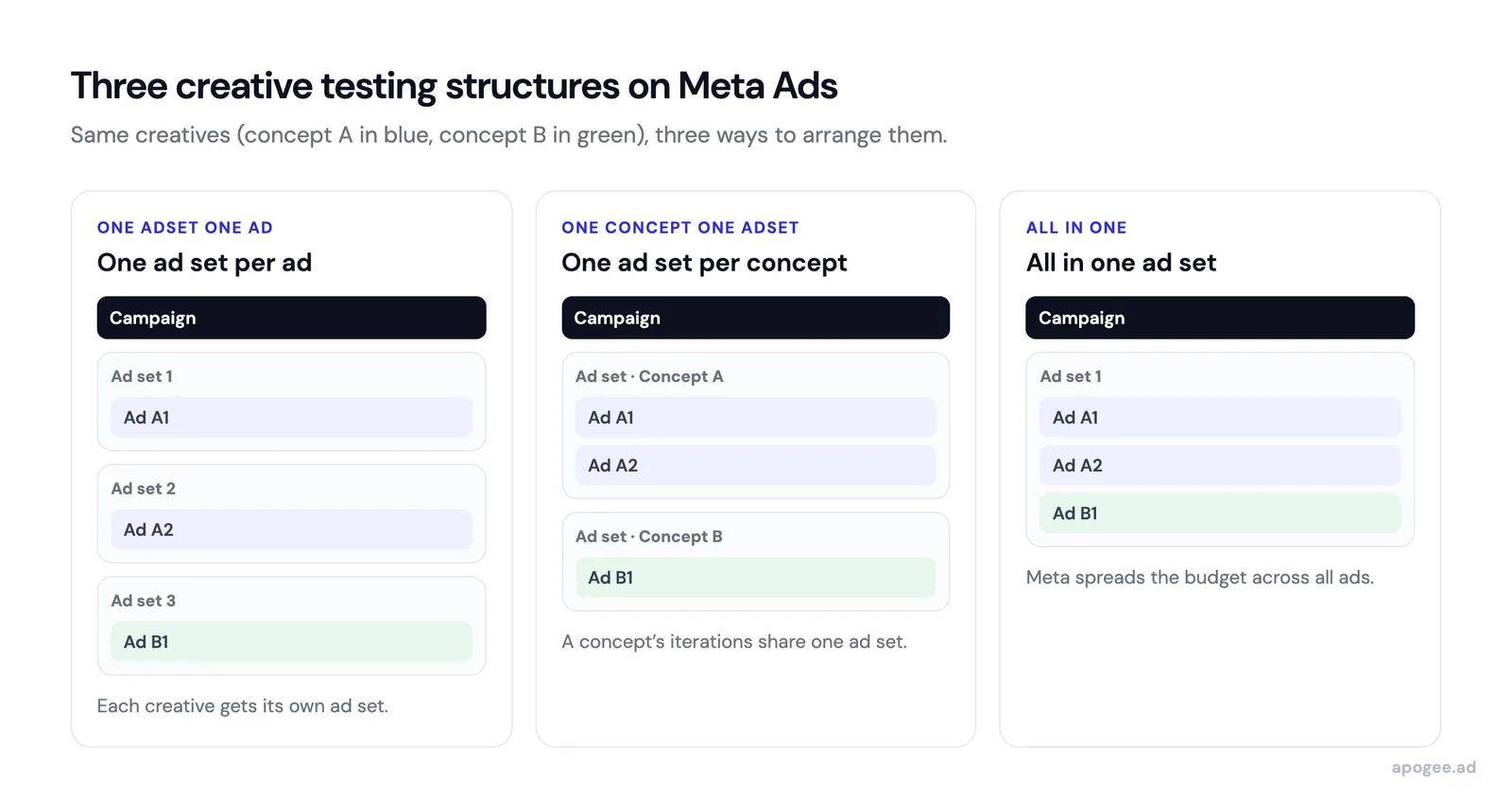
| 1 | How this creative performs, if the budget supports it | One AdSet One Ad |
| A few, same concept | Which iteration Meta prefers within one angle | One Concept One AdSet |
| The whole batch | Which ads Meta chose to deliver, and little about the rest | All-in-One |
One ad per ad set answers a narrow question: “does this creative work?”. If your question is “which angle works?”, our All-in-One vs One Concept One AdSet comparison covers the concept-level structure, which creates fewer ad sets. For the campaign and ad set levels above, see our guide to Meta Ads campaign structure.
ABO or CBO for a one ad per ad set test?
Under ABO, budget is set on each ad set. Under CBO, it lives at campaign level and Meta distributes it across ad sets. For a 1:1 test, ABO is the consistent choice: each creative gets the amount you planned, whatever its first days look like.
Under CBO, Meta concentrates the campaign budget on the ad sets it favors. The imbalance you were trying to avoid between ads comes back, this time between ad sets. CBO keeps its value elsewhere, in a campaign that delivers creatives already validated, hence the usual split between an ABO testing campaign and a CBO evergreen campaign.
How much budget does each ad set need?
The calculation starts from the learning phase threshold: about 50 results per ad set in a week. A result is the optimization event you chose: a purchase, a lead, a registration.
Here is a worked example to adapt to your account. At a $20 cost per result, one ad set needs about 50 × $20 = $1,000 over the week to reach the threshold, roughly $143 a day. Testing ten creatives one ad per ad set then takes about $10,000 a week. With $2,000 a week, the same account can fund two ad sets at that level, not ten.
The threshold is Meta’s guidance, not a guarantee. Our article on the Meta Ads learning phase covers what resets it. But if the calculation gives a number you cannot reach, the structure does not fit your budget.
What does the method not solve?
One AdSet One Ad has one real constraint: a high minimum budget per ad set. Each ad set needs enough spend to exit the learning phase, so isolating dozens of creatives requires a total budget that most small accounts do not have. Meta’s help center even points the other way: it recommends combining similar ad sets so their learning is combined too.
The structure also does not compensate for weak creative: perfectly isolating 50 mediocre ads gives you a clean read on 50 mediocre ads. If your budget is tight, grouping creatives with One Concept One AdSet or All-in-One is not a failure, it is the reasonable trade-off.
How do you read the results of a one ad per ad set test?
Read each ad set on the event it optimizes for, not on an intermediate metric picked after the fact. An ad set optimized for purchases is judged on cost per purchase; CTR or hook rate help explain why a creative wins or loses, not decide that it won. To track these numbers week after week, the Meta Ads reporting template gives the KPIs and their thresholds.
Three rules prevent most false verdicts:
- Wait for the learning phase to end. Meta says performance is less stable during learning and does not reliably predict future results: killing a creative on day two means judging noise.
- Do not edit anything during the test. A significant change to budget, targeting or creative can restart the ad set’s learning phase and reset the count.
- Compare comparable ad sets: same audience, same placements, same optimization event, same dates. Only the creative should change from one ad set to the next.
A winning creative then moves to the evergreen campaign, or joins an ad set that is already running. Adding an ad to a live ad set can also restart its learning, so it is a decision with a cost.
Common mistakes with one ad per ad set
Running the test under CBO is the most expensive one, for the reasons above. Next comes over-ambition: ten ad sets that never reach 50 results produce ten unusable reads, where three well-funded ad sets would have settled the question.
Creating one ad per ratio is another waste. The square, vertical and story versions of one creative belong in a single ad, using placement customization: splitting them multiplies ad sets without teaching you anything more.
Advantage+ creative enhancements, on by default for every new Meta ad, also skew the read when they crop or retouch the visual. Our guide to disabling Advantage+ covers the settings.
Finally, names without concept or iteration make it impossible to group results by angle once the test is over.
One ad per ad set vs Ads Manager’s built-in creative test
Ads Manager also offers a creative test inside an existing campaign. According to Meta’s help center (checked on October 6, 2026), you create 2 to 7 copies of an ad, reserve a share of the budget for the test ads (Meta recommends no more than 20%), then pick a duration and a comparison metric. The test only works with the highest volume bid strategy, does not report a confidence level, and makes no automatic change when it ends.
The built-in test suits a quick comparison of a few variants without building any structure. One ad per ad set remains the option when you test larger batches or want a guaranteed budget per creative.
How do you launch a One AdSet One Ad structure fast?
In Ads Manager, every ad set is created and named by hand: ten creatives, ten ad sets to configure. In Apogee, one ad set one ad is one of four testing structures available at bulk upload, alongside one concept one ad set, all in one, and insert into an existing ad set. The structure is picked from a card before launch.
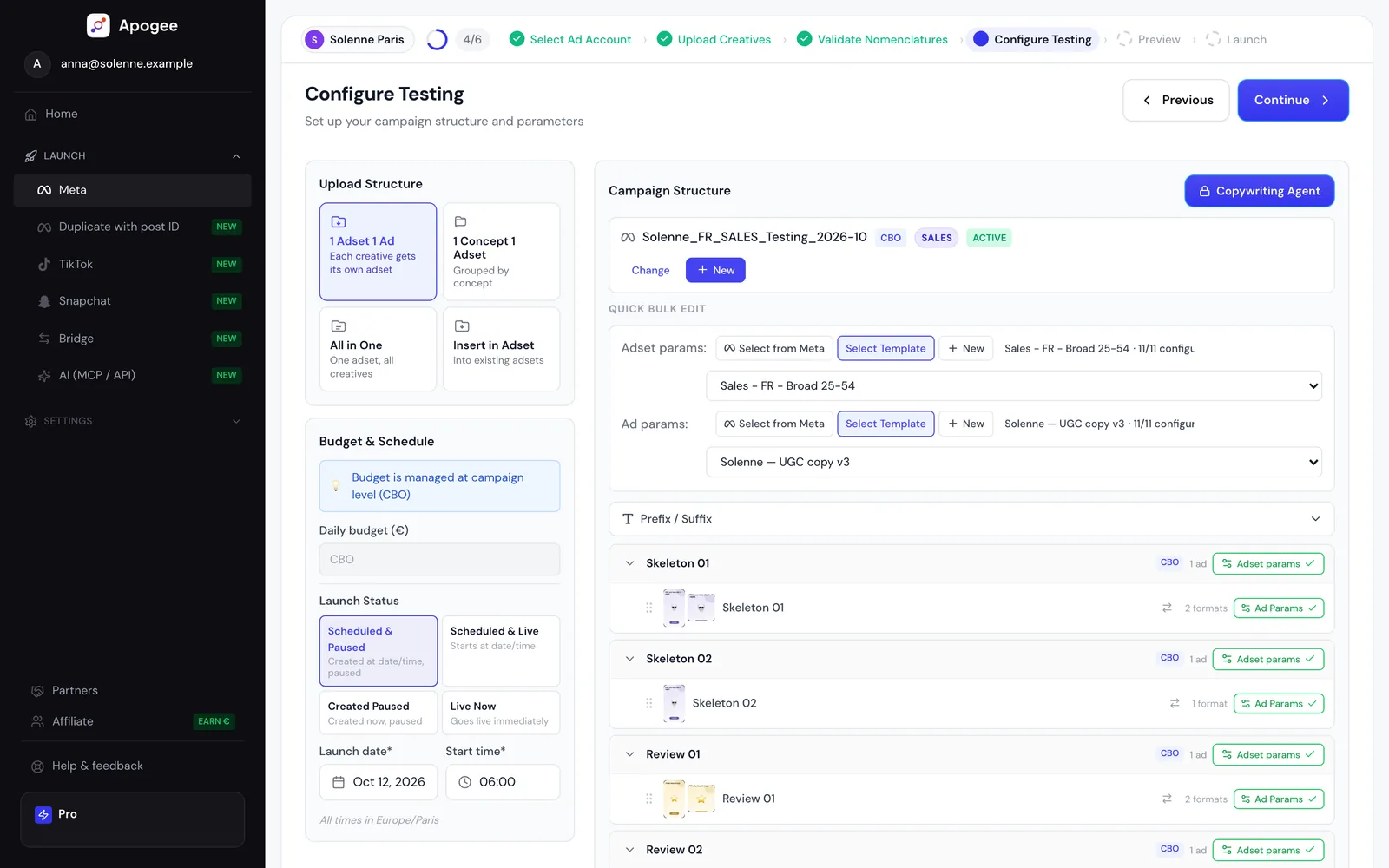
When you drop your creatives, Apogee creates one ad set per creative, named after the ad, and bundles every format of the same iteration into a single ad. Daily budget is set per ad set under ABO and disabled automatically under CBO. On the Pro and Scale plans, the eleven Advantage+ creative enhancements are exposed one by one and start switched off. Configuring a launch takes 47 seconds, whether you have 1 creative or 300, plus file transfer time.
The same structure exists on the three ad platforms Apogee supports: 1 Adgroup 1 Ad on TikTok Ads, 1 Ad Squad 1 Ad on Snapchat Ads. On those two platforms, Apogee only takes vertical 9:16 videos and the Sales objective.
Isolation gives a clean read per creative, but it does not lower the budget bar: each ad set still needs enough spend to exit the learning phase, so total budget grows with every creative you isolate.
Try Apogee for 7 days for €1, with no ad limit, and launch your next one ad per ad set test on Meta Ads, TikTok Ads or Snapchat Ads.
Related articles: