Test structure 10 min read
All-in-One Ad Set vs One Concept: Meta Creative Testing
All-in-One, One Concept One AdSet or one ad per ad set: pick a Meta creative testing structure by budget, ABO vs CBO, and learn how to read results.

Contents
- What are the 3 campaign structures on Meta Ads?
- What does the wrong structure cost you?
- What happens inside an All-in-One ad set?
- Why test by concept rather than by creative?
- Which structure should you choose for your account?
- ABO vs CBO: which budget mode for which structure?
- How do you read results for each structure?
- Common mistakes
- What does the structure choice not solve?
- Can you change structure without rebuilding everything?
Meta creative testing comes down to three structures: an All-in-One ad set puts the whole batch in one ad set and lets Meta choose, One Concept One AdSet creates one ad set per concept with its iterations, and One AdSet One Ad isolates each creative. What decides between them is not the number of creatives but the number of ad sets your budget can bring out of the learning phase, about 50 results per ad set per week according to Meta’s help center. One fundable ad set: All-in-One. A few: one per concept. As many as your creatives: one per creative, under ABO.
What are the 3 campaign structures on Meta Ads?
Give the same 30 creatives to two media buyers and you can get two completely different campaign trees: one dumps everything into a single ad set, the other builds one ad set per concept. Both call it creative testing, and both read very different results from the same assets. Each structure has its advantages and limitations, and the right choice depends on your budget, your test volume and what you want to read.
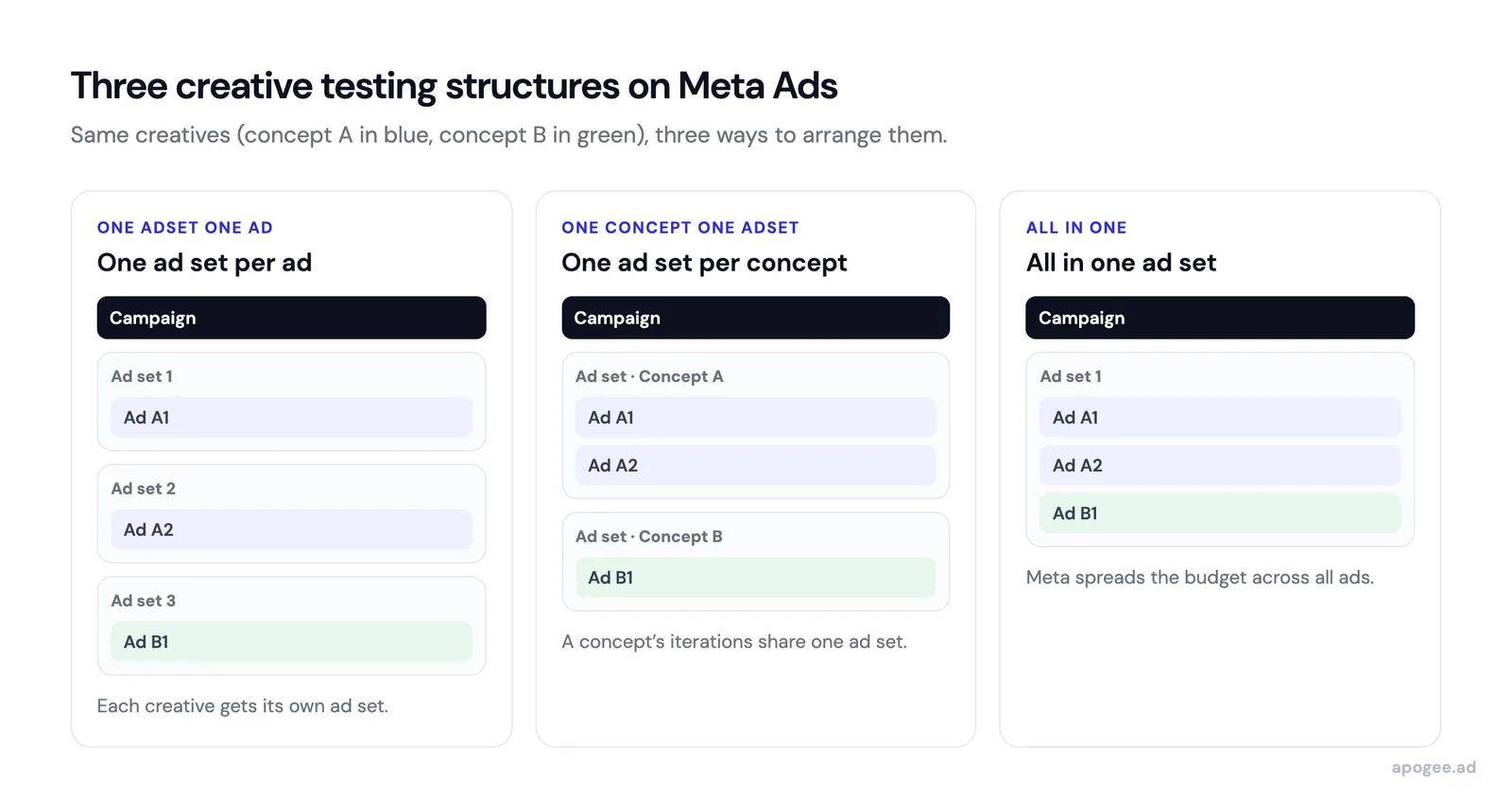
| Structure | What it creates | Unit you read | Ad sets to fund |
|---|---|---|---|
| All-in-One | One ad set for the whole batch | The batch, then the ads Meta picked | 1 |
| One Concept One AdSet | One ad set per concept | The concept (the angle) | 1 per concept |
| One AdSet One Ad | One ad set per creative | The creative | 1 per creative |
A fourth option, inserting into an existing ad set, does not open a new test: it adds ads to ad sets already running, to feed the ones that work.
What does the wrong structure cost you?
Choosing the wrong structure is expensive. An All-in-One ad set with 50 creatives sees delivery concentrate on a handful of them: you are not really testing the rest. One AdSet One Ad with a $500 weekly budget split across 50 ad sets gives $10 per creative: not enough to exit the learning phase. One Concept One AdSet is a good compromise, but it requires a disciplined naming convention to group iterations correctly. Without a dedicated tool, manually structuring these campaigns in Ads Manager takes time and multiplies the risk of configuration errors.
What happens inside an All-in-One ad set?
In an All-in-One ad set, Meta does not split budget evenly across the ads: delivery concentrates quickly on a few of them. Meta’s page on managing ad volume puts it this way: when too many ads run at once, each one delivers less often and fewer ads exit the learning phase.
All-in-One still has two real strengths. It needs a single learning phase, so a modest budget is enough to get out of it. And it follows the ad set consolidation Meta recommends on the same page. It answers the question “which creatives in this batch does Meta prefer?”, not “is this creative good?”. A creative that barely delivered in an All-in-One ad set is not a losing creative: it is an untested one.
Meta caps ad sets at 50 ads each: beyond that, a batch has to be split across several ad sets anyway.
Why test by concept rather than by creative?
A concept is an angle: a customer testimonial, a product demo, a before and after comparison. Its iterations change the hook, the voiceover, the length or the format, but keep the angle. One Concept One AdSet puts those iterations in the same ad set.
You then read results at the level that matters for the next production round: which angle deserves more iterations. Inside the ad set, Meta favors some iterations, and that is fine, since you are not trying to rank every variant. You also create fewer ad sets than with one ad per ad set, so each ad set gets more budget.
The price is naming discipline. If one concept shows up under three different names, its iterations end up in three ad sets and the per-angle read disappears. Our Meta Ads naming convention guide sets out a convention that writes concept and iteration into every ad name.
Which structure should you choose for your account?
The right starting point is a simple calculation: how many ad sets can your account bring to about 50 results in a week? The result is your optimization event: a purchase, a lead, a registration. Divide your weekly testing budget by 50 times your cost per result.
| Ad sets you can fund per week | Recommended structure | Why |
|---|---|---|
| One | All-in-One, or Ads Manager’s built-in creative test | Splitting the budget would keep every ad set stuck in learning |
| A few | One Concept One AdSet | One ad set per angle, each with enough budget to produce a read |
| As many as the creatives to test | One AdSet One Ad | Each creative gets its own budget and clean metrics, if you can sustain the spend |
A worked example to adapt to your account: at a $20 cost per result, one ad set needs about $1,000 a week. With $3,000 a week set aside for testing, you can fund three ad sets, so three concepts with One Concept One AdSet, not fifteen isolated creatives.
One Concept One AdSet only gives a readable signal per angle if your naming convention groups iterations correctly: without that discipline, iterations of the same concept end up scattered and the per-concept read disappears.
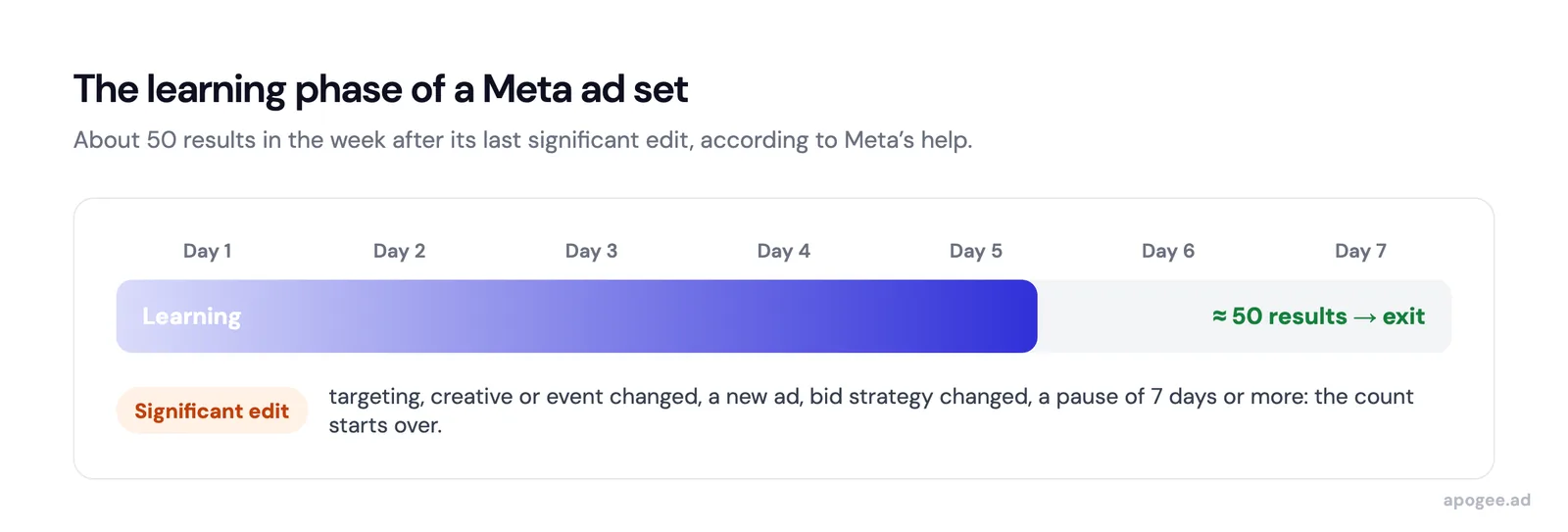
The 50 result threshold comes from Meta’s help center and is guidance, not a guarantee: use it to size the structure, not to predict the outcome. Our article on the Meta Ads learning phase covers what resets it, and the one ad per ad set method details the budget per isolated creative.
ABO vs CBO: which budget mode for which structure?
Under ABO, budget is set per ad set. Under CBO, it is set at campaign level and Meta distributes it across ad sets.
With All-in-One, the question does not arise: there is only one ad set. As soon as the test relies on several ad sets you want to compare, with One Concept One AdSet or One AdSet One Ad, ABO guarantees each one its planned budget. Under CBO, Meta can underfund a concept or a creative from the first days, and the comparison loses its common ground. CBO earns its place in the campaign that delivers the winners, where the goal is no longer to compare but to spend where it pays. Our guide to Meta Ads campaign structure covers that testing and evergreen split.
How do you read results for each structure?
In an All-in-One ad set, start with how spend was distributed. The ads that received most of the budget can be compared with each other. The ones that barely delivered cannot be judged: if the angle looks solid, they deserve another run in a different test. The Meta Ads reporting template gives the KPIs to track and their thresholds, whatever the structure.
With One Concept One AdSet, compare ad sets against each other on the optimization event: that is the per-angle read. Inside an ad set, the most delivered iterations show what Meta picked, without being a test in the strict sense.
With One AdSet One Ad, each ad set is read on its own, once it has exited learning. Everywhere, one rule holds: do not edit an ad set during the test, because a significant edit can restart its learning phase.
Common mistakes
The most expensive one is choosing the structure from the number of creatives received rather than from the budget. Fifteen creatives do not justify fifteen ad sets if the account can only fund three.
Next comes testing several ad sets under CBO, covered above. Third: splitting the ratios of one creative into several ads. The square, vertical and story versions belong in a single ad, using placement customization.
Finally, Advantage+ creative enhancements are on by default for every new Meta ad. They can crop or retouch a visual during the test, and the variable you meant to isolate is no longer the only one moving. Our guide to disabling Advantage+ covers the settings.
What does the structure choice not solve?
No structure compensates for weak creative. All-in-One, One Concept One AdSet, and One AdSet One Ad decide how budget gets distributed, not whether your ads deserve it: a losing concept loses in all three. One AdSet One Ad also comes with a real constraint, a high minimum budget per ad set, since each one needs enough spend to exit the learning phase. Switching structures every two weeks prevents you from comparing one cycle with the next. And switching structures will not fix an offer that does not convert. Pick the structure that matches your volume and budget, then put the real work into the creatives themselves.
Can you change structure without rebuilding everything?
In Ads Manager, changing structure means rebuilding ad sets by hand. Apogee offers four testing structures at bulk upload: one ad set one ad, one concept one ad set, all in one, and insert into an existing ad set. The choice is made from a card before each launch, without rebuilding your campaigns.
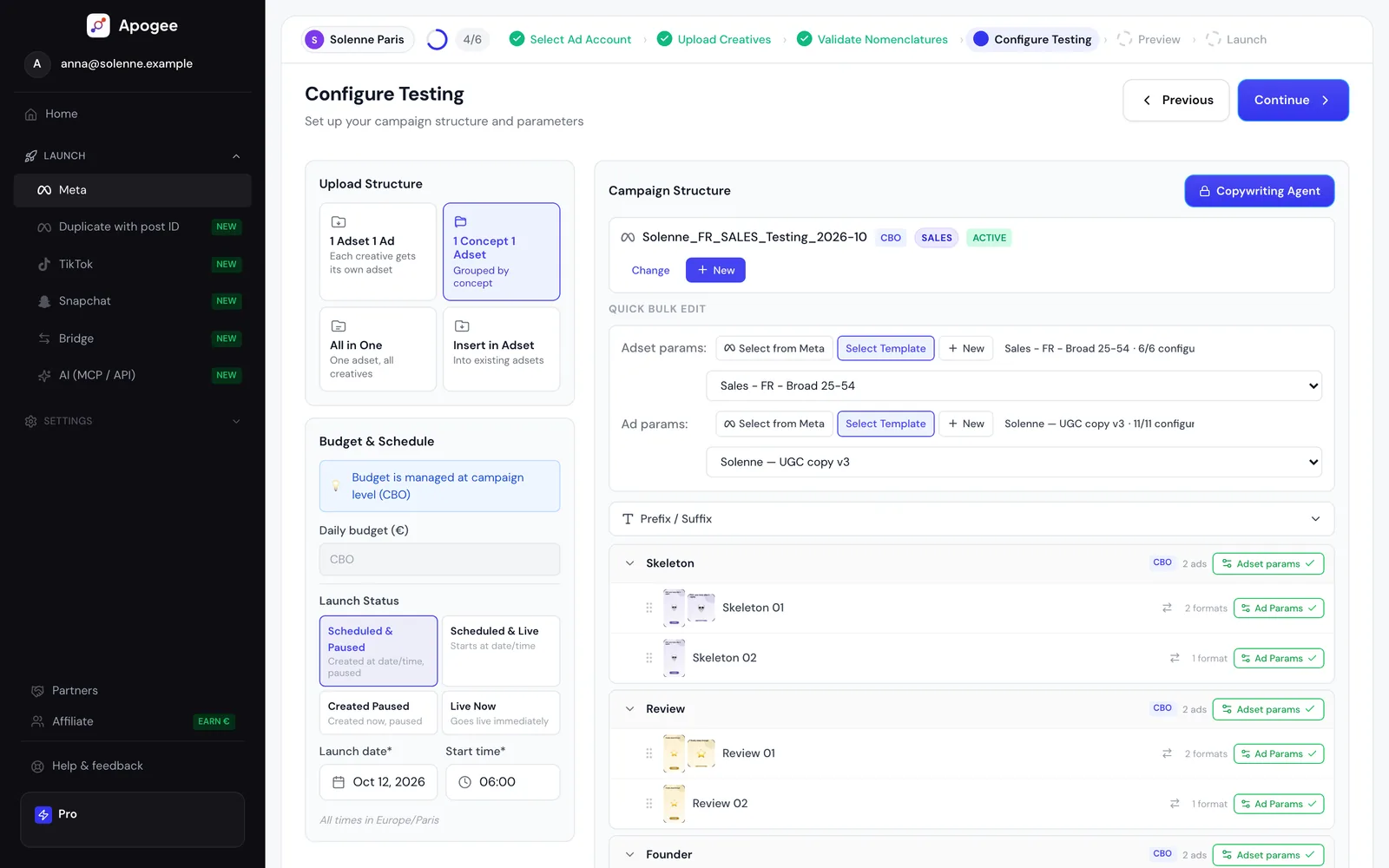
Grouping by concept relies on the naming detection step: Apogee reads concept and iteration from each file name, and one concept one ad set creates an ad set named after each concept. One ad bundles every format of the same iteration; the video and image versions of a concept go into two separate ads. Budget is set per ad set under ABO and disabled automatically under CBO.
Insert mode adds creatives to several existing ad sets in one go, with a CBO or ABO badge on each, without touching the names of ad sets already running.
Insert is not a new test: it adds creatives to existing ad sets without creating new campaigns, which is useful for feeding proven ad sets rather than starting a new read.
The four structures also exist on TikTok Ads and Snapchat Ads, in each platform’s vocabulary: ad group on TikTok, ad squad on Snapchat. On those two platforms, Apogee only takes vertical 9:16 videos and the Sales objective, and TikTok accepts at most 50 ads per ad group.
Try Apogee for 7 days for €1, with no ad limit, and pick your testing structure at your next launch on Meta Ads, TikTok Ads or Snapchat Ads.
Related articles: